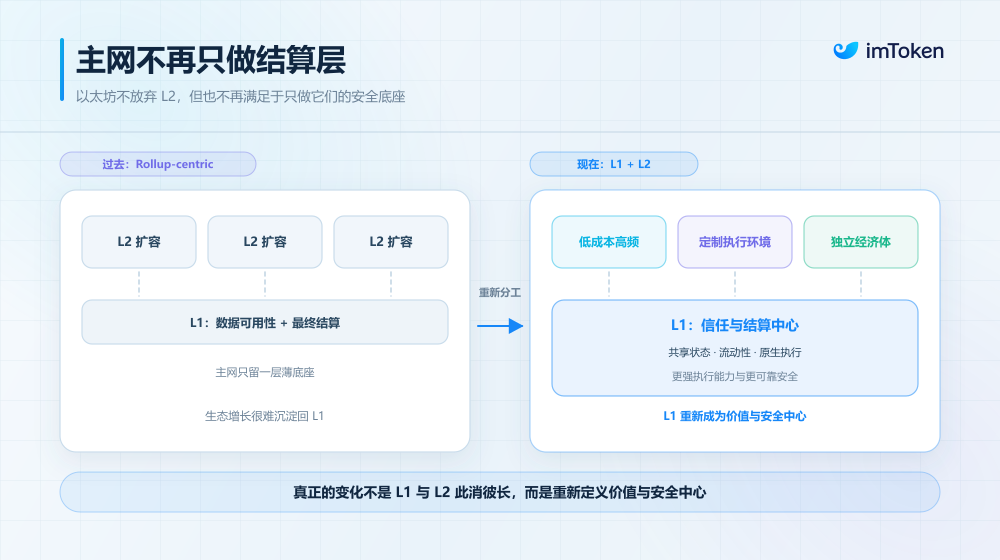
Originally reported November 11, 2026, at 18:26 (UTC+8). Several Ethereum projects had recently decided that running a separate L2 was no longer the best fit for their applications. Their decisions do not amount to an ecosystem-wide retreat from rollups. They do, however, put a practical question back on the table: which work needs its own execution environment, and which assets and operations are better kept on Ethereum L1?
The cost of a separate chain
ENS provides a clear example. In 2024, ENS Labs planned a dedicated ZK rollup, Namechain, for ENSv2. In February 2026, ENS co-founder Nick Johnson announced that Namechain development would stop and ENSv2 would instead deploy on Ethereum mainnet. He cited L1 scaling that had progressed much faster than expected two years earlier. According to figures disclosed by ENS Labs, the average gas cost of an ENS name registration had fallen roughly 99% over the preceding year, from nearly $5 to less than $0.05. The source also notes the additional costs and complexity of operating an L2, including infrastructure, bridging, cross-chain resolution, audits and maintenance.
Other decisions reflected different needs. Synthetix launched its new perpetuals exchange on Ethereum mainnet in December 2025 after criticizing liquidity fragmentation and infrastructure instability across L2s. In 2026, Trueo announced plans to move its primary deployment from Base to L1; ShapeShift moved its rFOX staking program from Arbitrum to L1, where it said most FOX tokens were already held; and Superseed stopped its L2 while planning to move core products to mainnet. Nillion began moving node operations previously run on its L2 to Ethereum mainnet and planned to phase out that L2.
The article also reports pressure on standalone networks: Blast announced on October 2 that it would cease operations, citing costs that exceeded L2 revenue and no reliable path to sustainability. Abstract subsequently announced a plan to close its network on December 15. That date was still in the future when the original article was published.
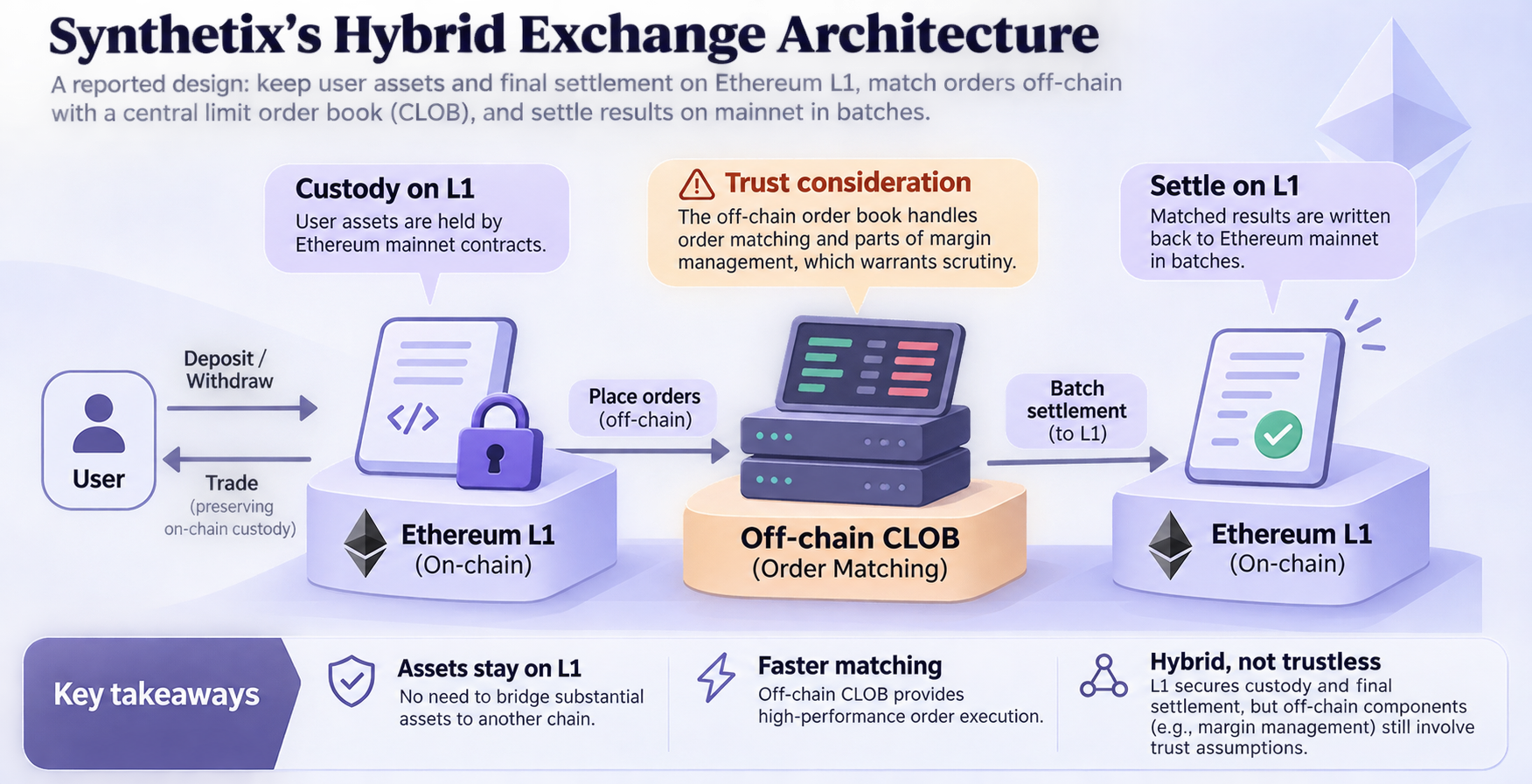
What stays on L1?
The architectural choice is not simply “L1 or L2.” The article describes Synthetix’s exchange as a hybrid: Ethereum L1 contracts custody user assets, an off-chain central limit order book matches orders, and results are settled in batches on mainnet. This avoids requiring users to bridge substantial assets to another chain for faster matching. It does not eliminate trust questions: the article notes that parts of margin management still depend on the off-chain order book, which itself warrants scrutiny.
The broader concern is fragmentation of assets and liquidity across networks. The article says that, as of November 2026, ETHBEAT tracked dozens of L2s, but only a single-digit number had reached Stage 2, while major rollups including Base, Arbitrum One and OP Mainnet remained at Stage 1. It cautions that some networks may choose to retain administrative powers for regulatory or commercial reasons; they should not, on that basis, be treated as fully decentralized extensions of L1.
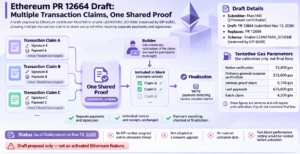
Native Rollup research and proposals such as the Ethereum Economic Zone aim at closer verification or interaction between rollups and mainnet. They remain research or development directions in the article—not activated Ethereum upgrades. L2s may still suit applications needing high-frequency execution, privacy features or greater control over their execution environment.
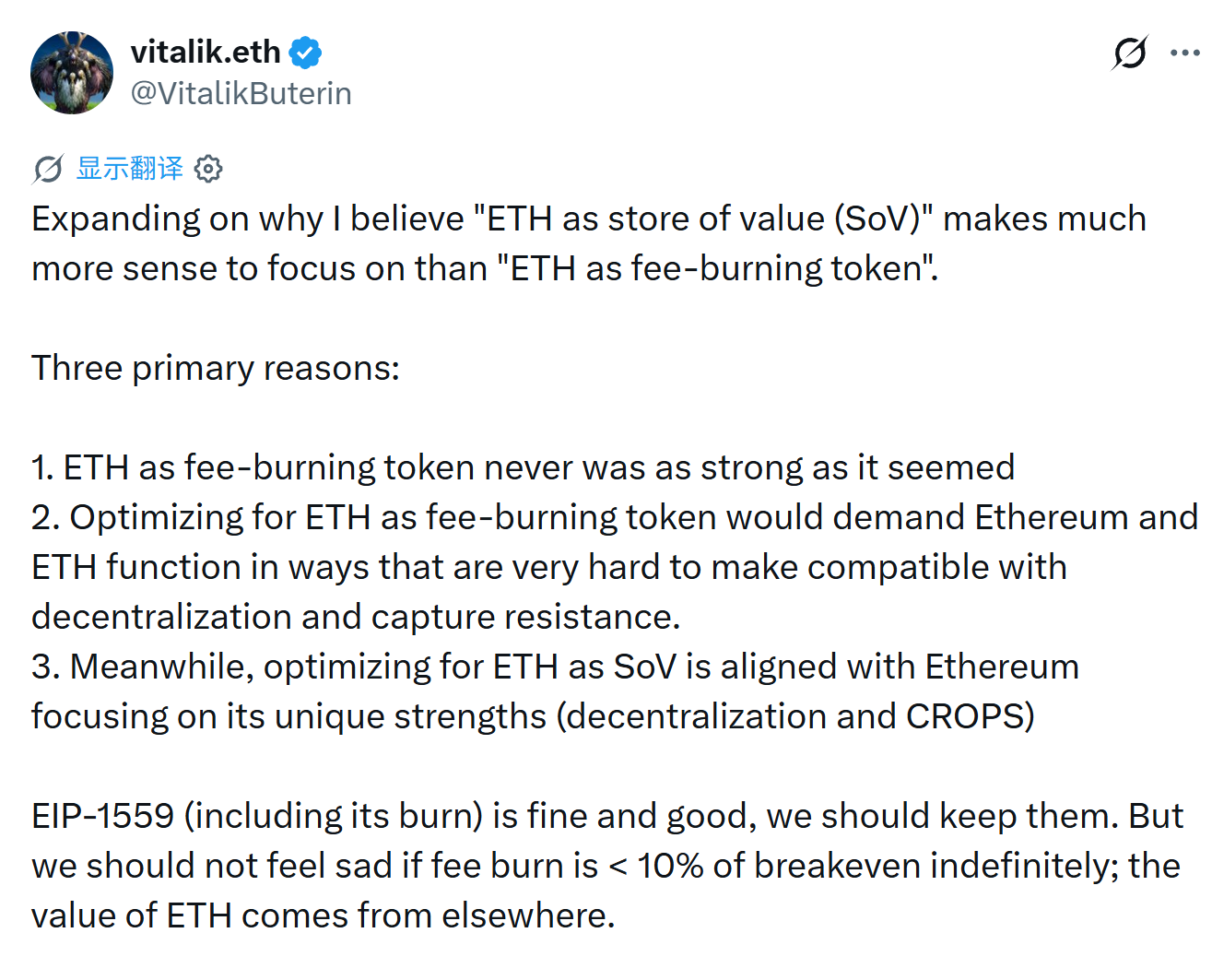
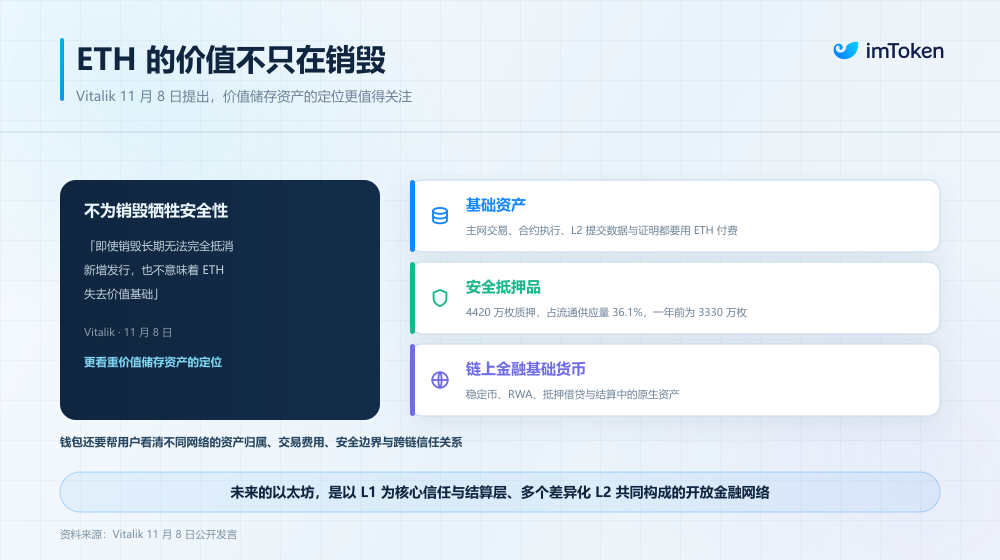
The ETH value question
Cheaper transactions also complicate a familiar account of ETH’s value. Under EIP-1559, the base fee is burned and the priority fee goes to validators. If L1 capacity rises and L2 data posting becomes cheaper, more activity need not translate into proportionally more fee burn.
The article attributes a different emphasis to Vitalik Buterin: keep EIP-1559’s burn mechanism, but do not make high fees the central case for ETH’s long-term value. It says he considers ETH’s role as a store-of-value asset and Ethereum’s decentralization, resistance to censorship and control, open-source character, privacy and security more important than maximizing burn. Those are arguments about long-term value, not a demonstrated price outcome.
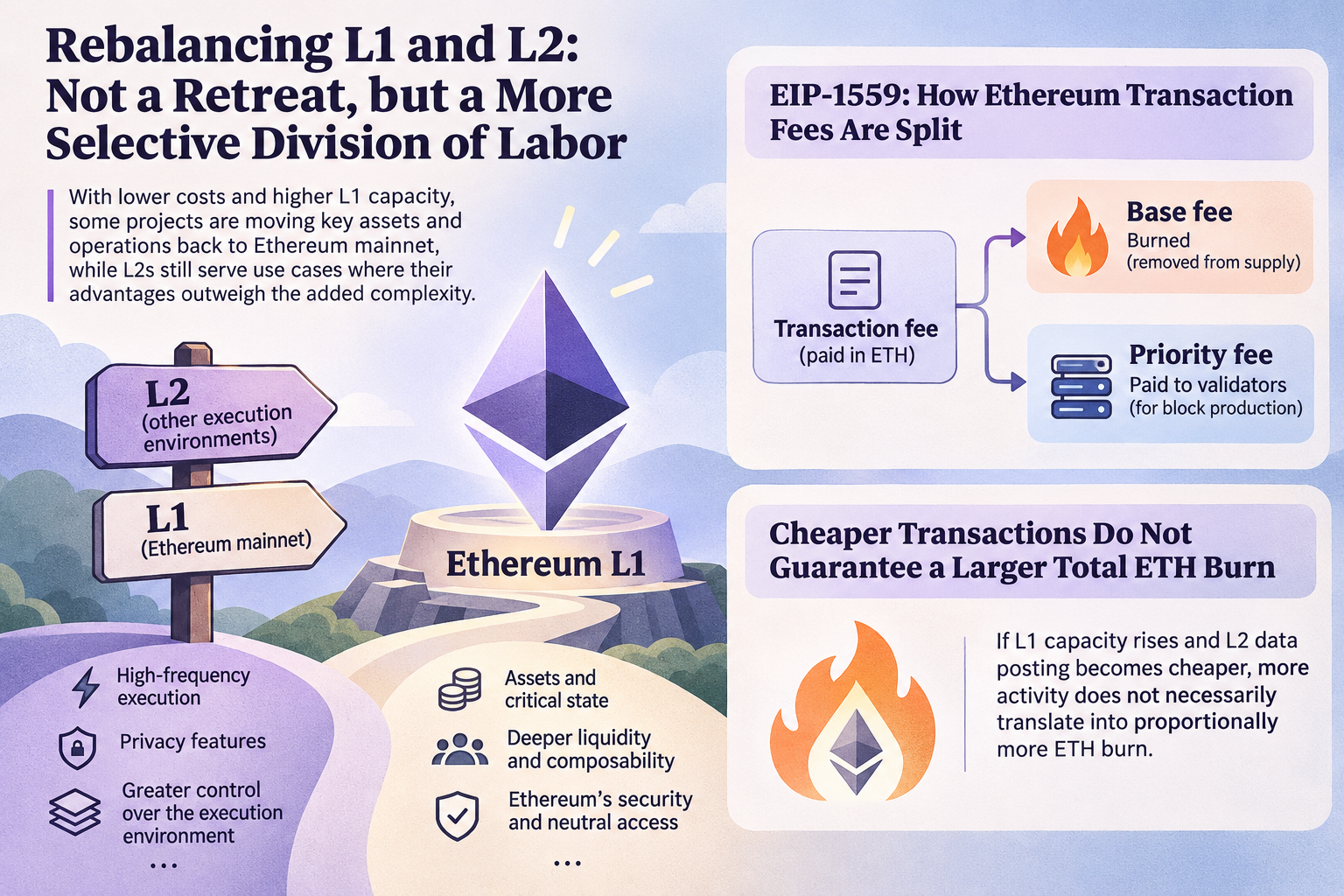
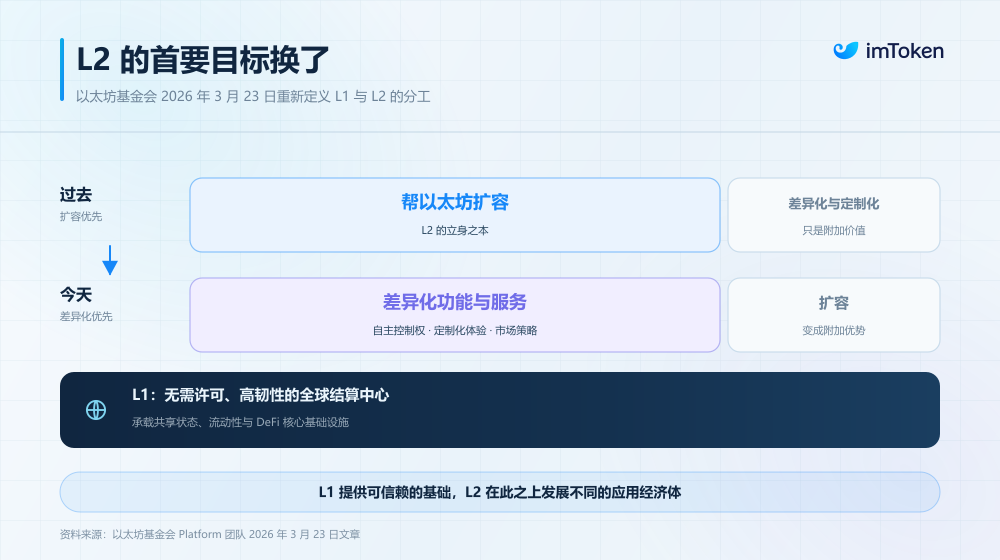
Taken together, the reported moves suggest a more selective division of labor: keep assets or critical state on L1 when its security, liquidity and shared access justify doing so, and use other execution environments where their advantages outweigh their operational and trust costs. The examples do not establish that L2s as a whole are disappearing.
Source: odaily.news (originally published 2026-11-11 18:26 UTC+8)