As reported on November 21, 2026, imToken had chosen to remain cautious about broadly introducing EIP-7702 into its wallet, stop new product-development investment in ERC-4337, and gradually shift its research focus toward native account abstraction. The distinction matters: EIP-7702 is active on Ethereum mainnet, while the native-account-abstraction approach discussed here remains a direction for future protocol development.
What changes when an account becomes programmable?
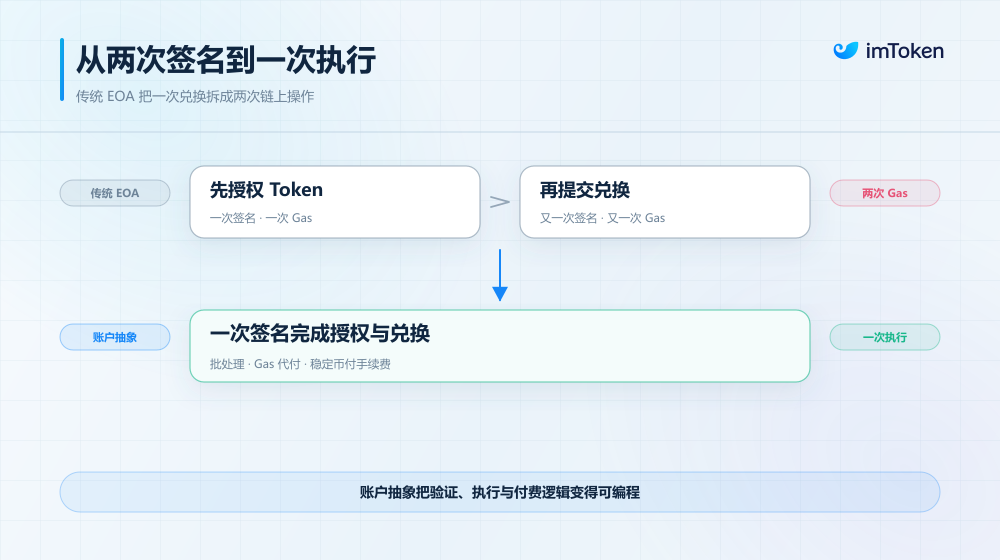
A conventional externally owned account (EOA) is controlled by a private key. Account abstraction (AA) aims to make aspects of account validation, execution and fee payment programmable. That could support operations such as batching transactions or having another party pay Gas, but it also makes the meaning of a wallet authorization harder to assess.
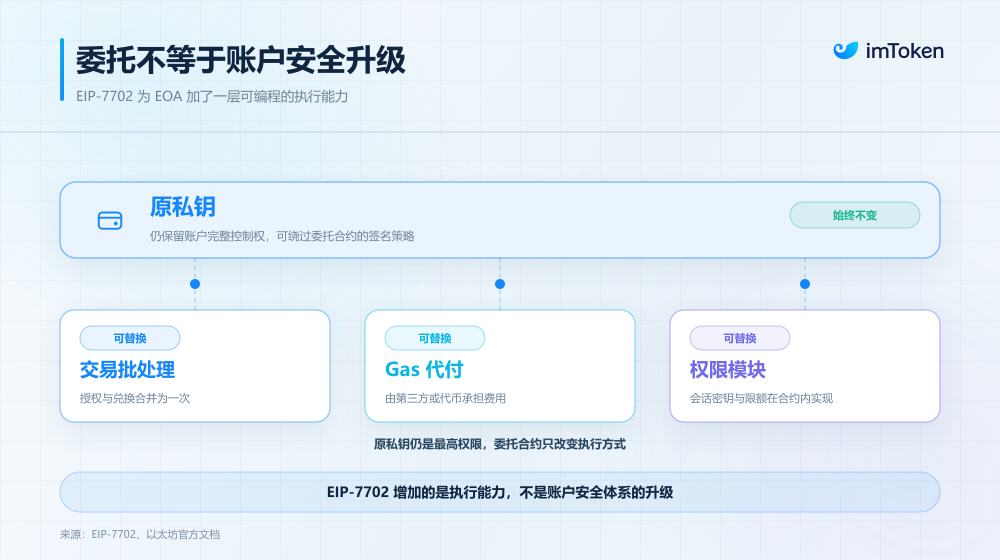
EIP-7702 lets an EOA authorize delegation to code at a deployed contract address. That can give an existing account new capabilities without replacing its address. It also means that authorizing unsuitable or vulnerable code may put more than a single token allowance at risk: delegated code runs in the account’s context and, depending on its permissions, could affect ETH, ERC-20 assets and subsequent operations. The original private key retains control of the EOA, even if the delegated contract implements additional signing rules. Removing a delegation cannot undo transfers or other on-chain changes that have already occurred.
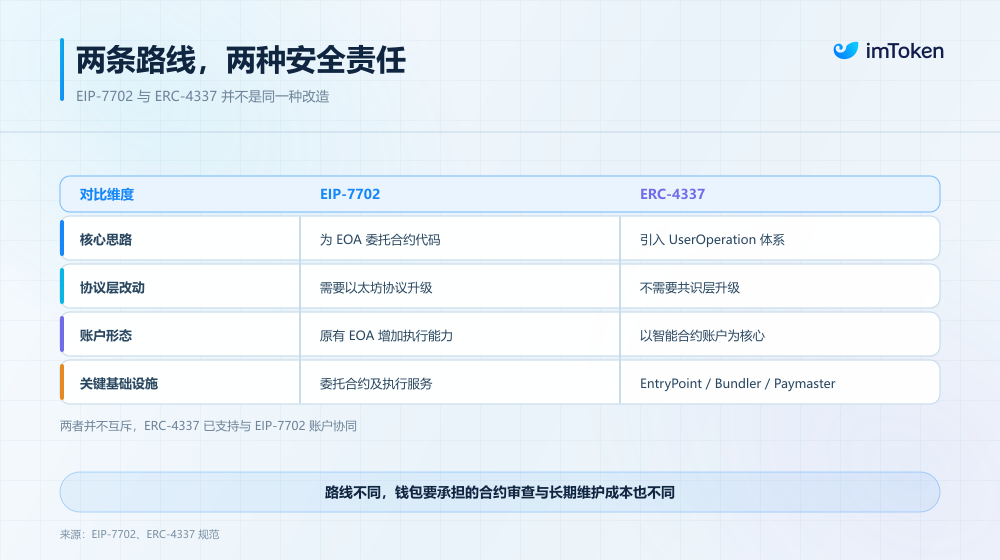
ERC-4337 takes a different route through smart accounts and supporting infrastructure. A wallet creates a signed UserOperation; a Bundler checks it through EntryPoint simulation and submits it on-chain, where EntryPoint performs validation before execution. A Paymaster may participate when fees are sponsored, and a Factory may be involved when a new account is created. The components offer flexibility, but their implementations, versions and configuration also create compatibility and maintenance obligations. The two approaches are not mutually exclusive: ERC-4337 has added support for EIP-7702.
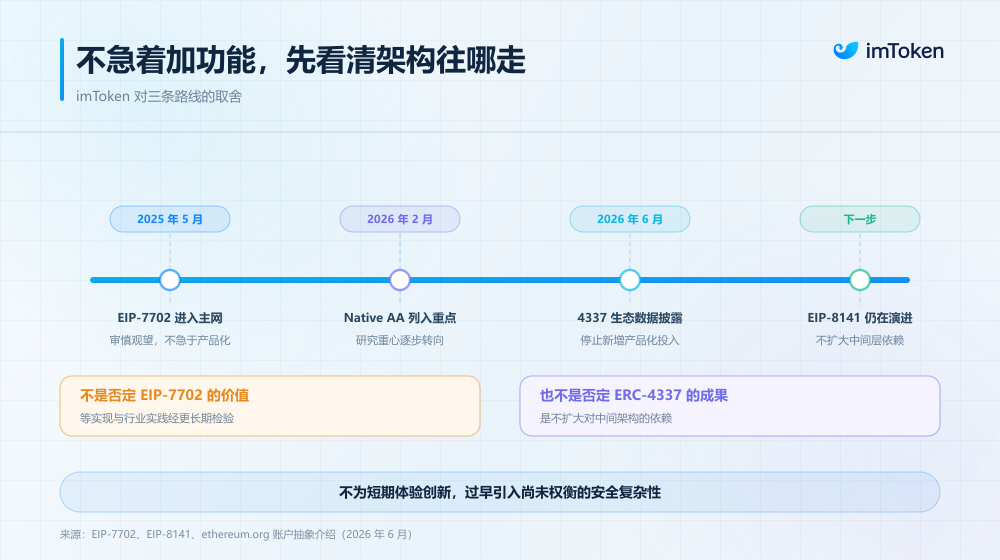
Why imToken favors waiting
The November 2026 account describes imToken’s EIP-7702 position as cautious rather than a rejection of its capabilities. Its concern is whether users can distinguish account delegation from an ordinary signature, and whether contract review, permission displays and recovery practices are mature enough for broad deployment.
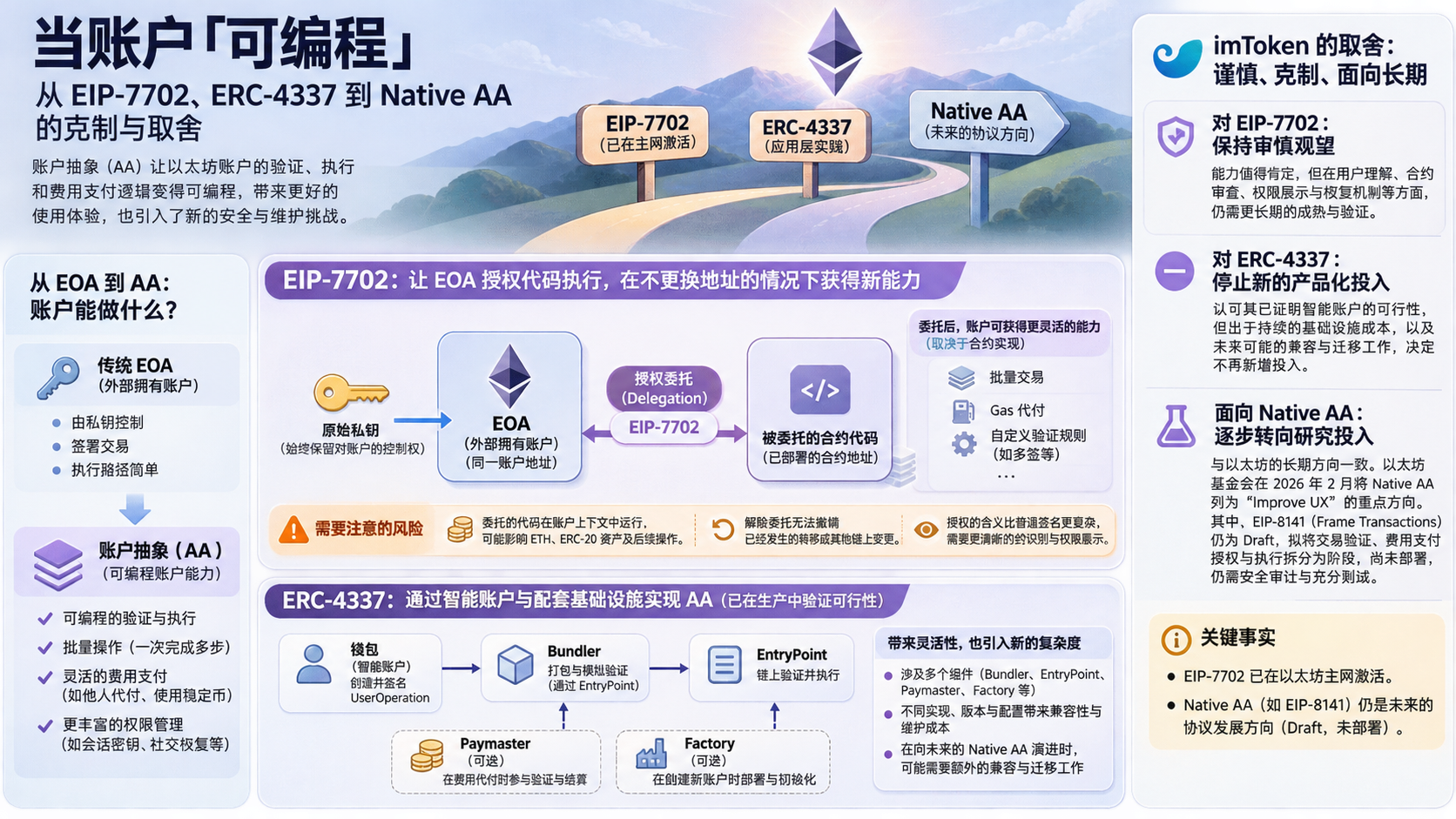
The account likewise credits ERC-4337 with demonstrating that smart accounts can work in production. It frames imToken’s decision to stop new ERC-4337 product-development investment as a judgment about ongoing infrastructure costs and possible future compatibility and migration work—not as a claim that ERC-4337 has been withdrawn or that existing deployments have stopped working.
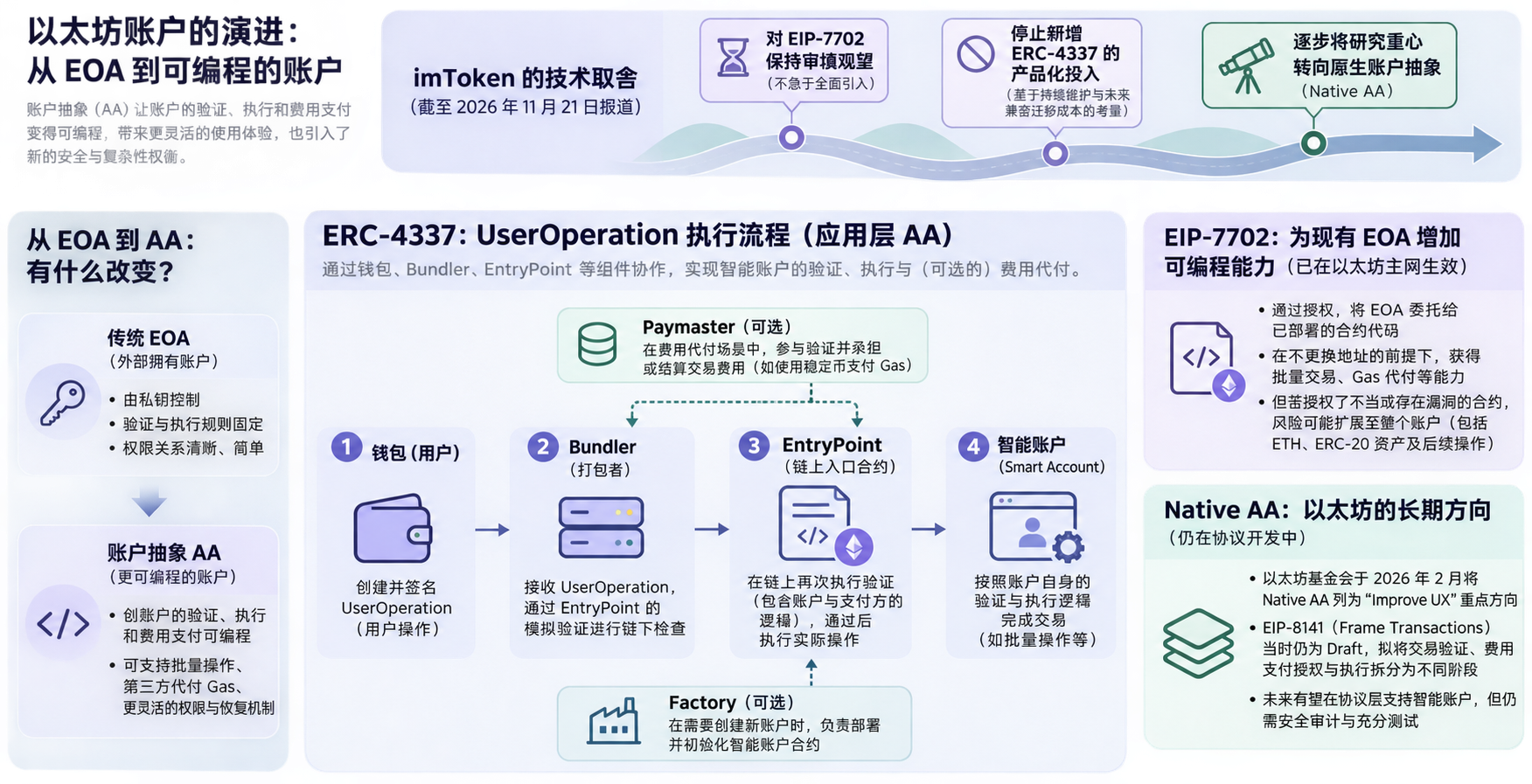
The longer-term alternative is still under development. According to the account, the Ethereum Foundation identified native AA as a priority under its “Improve UX” work in February 2026. EIP-8141, or Frame Transactions, was still a Draft at the time of reporting. It proposes separating transaction validation, fee-payment authorization and execution into stages; it was not a deployed native-AA upgrade. Even if protocol-level support eventually reduces reliance on peripheral infrastructure, account validation code and new fee mechanisms would still need security review and testing.