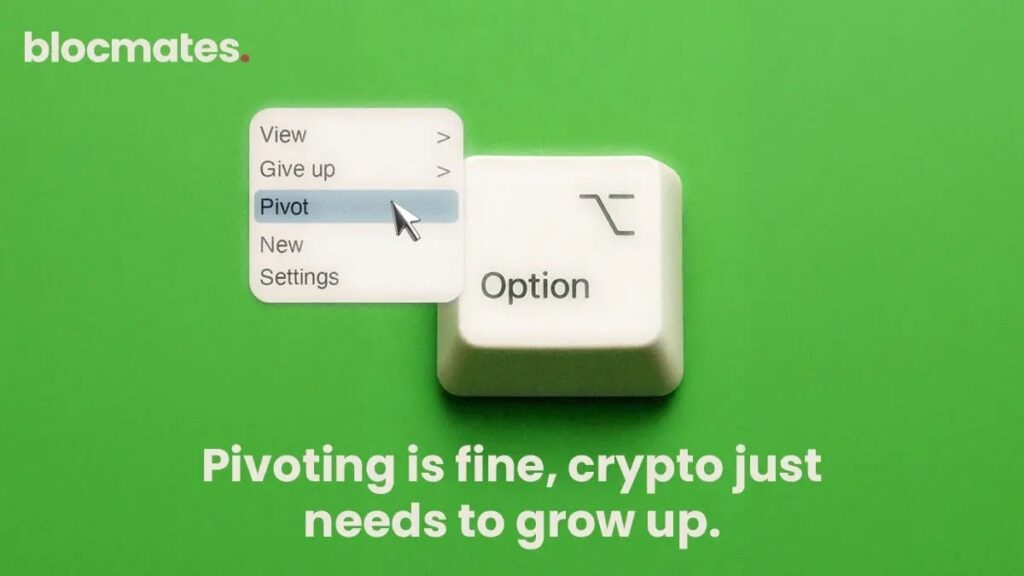
In a commentary published on November 23, 2026, 563defi argued that crypto teams should not be condemned simply for changing direction when an earlier product has not found a market. The survey spans Ethereum-adjacent staking projects, an L2, and teams from other parts of crypto. Its examples describe different kinds of change—not a shared protocol upgrade or evidence that every new product has succeeded.
Restaking teams take different paths
The commentary says ether.fi, which began as a liquid restaking protocol connected to EigenLayer, still retains that business but now offers a broader set of financial products, including a Visa-supported crypto debit card, yield vaults, lending, spot trading and a stablecoin.
Renzo Protocol has rebranded as Renzo Finance and repositioned itself as an asset-management platform. According to the commentary, it launched Renzo Basis, a delta-neutral basis-trading vault on Hyperliquid, on the day of the rebrand, and is seeking to expand its vault offerings to other chains and perpetual-futures exchanges. Kelp, following a hack, has also turned toward strategy vaults in partnership with Gains Network; its KUSD stablecoin remains a plan aimed at institutional payments and foreign-exchange settlement.
Other former restaking peers are pursuing distinct products. Bedrock has shifted its focus toward Bitcoin assets and yield vaults. Puffer remains focused on infrastructure: its UniFi work targets cross-chain settlement for based rollups sequenced by Ethereum L1. The writer cites pre-confirmations below 100 milliseconds and presents settlement for AI agents as a potential use case, not an established outcome. Swell announced Faro, a non-custodial AI trading application built on Hyperliquid, in October 2026.
Applications and network strategies
For MegaETH, the change is from building L2 capacity toward building an application on that infrastructure. The commentary says the team allocated $30 million to first-party products, beginning with Purified Intelligence, a proposed AI inference marketplace expected to appear in December 2026. Its stated aims include standardizing inference services and using on-chain verification; those aims should not be mistaken for demonstrated capabilities.
The survey also describes Moonbeam as having announced in July 2026 that it would move its core business and GLMR token to Base, with a new focus on coordination and settlement among AI agents. It says Abstract parent Igloo has narrowed its focus from a consumer L2 strategy to Pudgy Penguins, NFTs and PENGU, while Nillion has narrowed its privacy-computing work toward a “Hidden Intent” primitive called Covenants. These are project strategies, not Ethereum protocol changes.
Moves beyond Ethereum infrastructure
The writer says Golem introduced Arkiv, a queryable, tamper-resistant Web3 data-infrastructure project intended to use GLM for fees, at an Ethereum Devcon event earlier in November 2026. Immutable, the commentary says, cut nearly all of its internal game-development team in June 2026 and opened its Audience AI marketing-analytics platform to studios with unreleased Steam games in August. The writer also reports that IMX was down 99% from its all-time high at the time of writing.
The commentary describes Harmony as shifting toward AI video creation after an August 2026 security incident. Its account says an attacker forged roughly 3 trillion ONE tokens, followed by a contentious on-chain rollback, and that the team chose to reissue tokens on Ethereum rather than shut down. Those incident details and the characterization of the team’s decision are the commentary’s claims.
The writer’s conclusion is an argument for judging teams by whether their products meet user needs rather than treating a pivot itself as a failure. The cases above show changes in direction, but the commentary does not establish that the new strategies have found product-market fit.