Staff at the U.S. Commodity Futures Trading Commission said on 23 November 2026 that regulated derivatives exchanges and clearinghouses may count Bitcoin, Ether and payment stablecoins toward the financial resources they must hold to cover at least 12 months of operating costs. The account below follows reporting published on 24 November 2026. According to Cointelegraph, the advisory came from staff in the Division of Market Oversight and the Division of Clearing and Risk, reflects those staff views, and is not a formal rule change approved by the Commission.
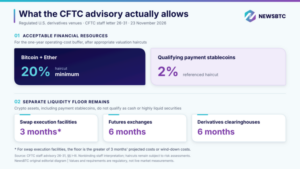
Cointelegraph reported that CFTC rules already require derivatives exchanges, swap trading venues and clearinghouses to hold enough financial resources to cover at least 12 months of operating costs on a rolling basis. Staff said they would accept a haircut of at least 20 percent on Bitcoin and Ether and at least 2 percent on qualifying payment stablecoins when those assets are applied to that operating-cost buffer. At a 20 percent haircut, one dollar of Bitcoin or Ether counts as 80 cents or less. The reporting does not name which payment stablecoins qualify.
The same assets do not meet a separate liquidity requirement. PANews reported that staff said crypto assets are not cash or highly liquid securities under generally accepted accounting principles, so they do not qualify for that test. Venues still need cash or highly liquid securities for reserves that must stay immediately available. Holding only digital assets does not satisfy both tests.
Cointelegraph listed affected CFTC-regulated entities as including Coinbase Derivatives, Crypto.com’s North American Derivatives Exchange and Bitnomial Exchange, plus the prediction markets Kalshi and Polymarket US. The operating-cost rule Cointelegraph described also covers swap trading venues and clearinghouses.
PANews, citing crypto journalist Eleanor Terrett, reported that the relevant rules had not clearly stated whether cryptocurrency could count toward the operating-cost requirement, and that the staff guidance is meant to clarify that point. Because the text is staff guidance rather than a Commission-approved rule, it does not by itself decide whether the Commission will later adopt the haircuts through formal rulemaking, and it does not bind later staff positions. The reporting pointed to later reserve disclosures from the named venues as the place to see whether firms describe Bitcoin, Ether or stablecoins inside the operating-cost buffer.
Price figures published with that reporting are a separate snapshot, not a stated effect of the advisory. CoinPaprika data timestamped 24 November 2026 at 01:36 UTC showed Bitcoin at $61,472 (₹5,707,832), up 1.3 percent over 24 hours and down 4.6 percent over seven days, with a market capitalization of $1.24 trillion and 24-hour volume of $27.07 billion.
The guidance is not an Ethereum protocol change. It does not alter Ether’s issuance, staking or settlement, and it does not activate a network upgrade. It concerns only how CFTC-regulated derivatives venues may value Bitcoin, Ether and qualifying payment stablecoins when demonstrating coverage of a year of operating costs, while the liquidity test remains limited to cash and highly liquid securities.