As of the original report on November 19, 2026, Ethereum’s post-quantum work was a research and engineering roadmap—not an activated protocol upgrade. The Ethereum Foundation’s stated target, in protocol priorities published that September, was to make Ethereum L1 resistant to quantum attacks across its execution, consensus and data layers by December 2029. That date was a goal, not a guarantee.
What would need to change?
A sufficiently capable fault-tolerant quantum computer running Shor’s algorithm could, in theory, undermine the elliptic-curve cryptography used by ordinary Ethereum accounts and validator signatures. The report noted that no quantum computer capable of breaking this cryptography existed at the time. The concern was the time a network-wide migration would take, not an immediate need for users to move assets.
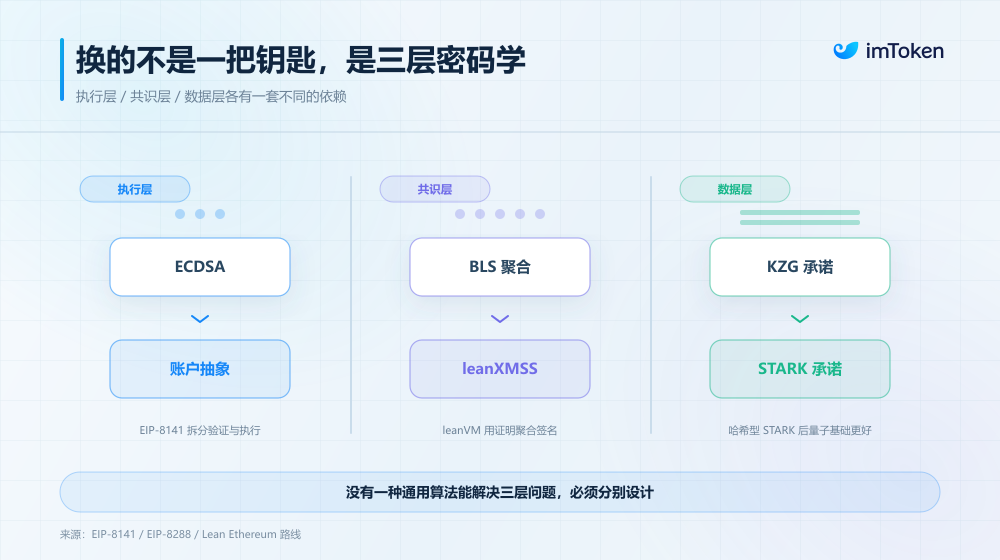
The exposure differs by component:
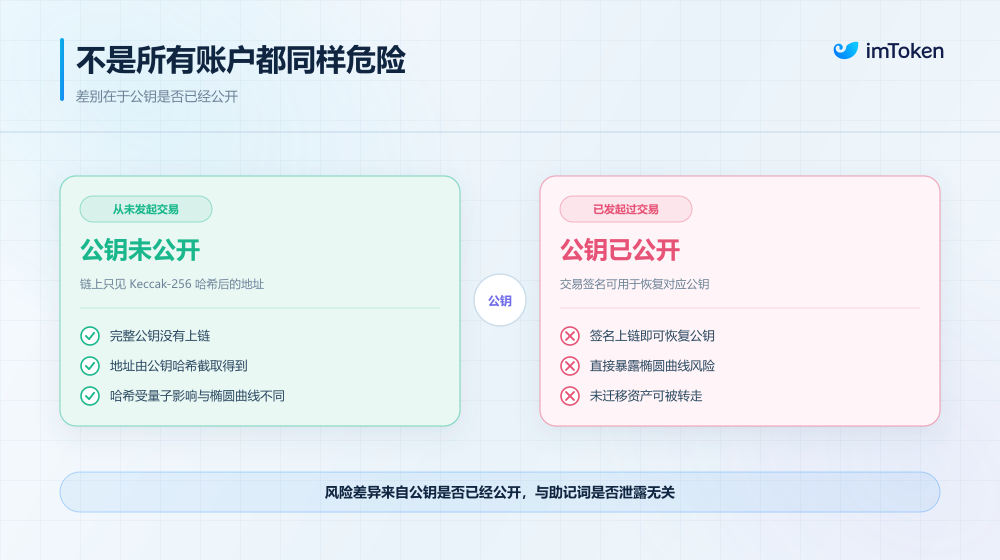
- Accounts: Externally owned accounts use ECDSA signatures. An address whose public key has not been revealed has a different exposure from one that has signed a transaction: a published transaction signature allows the public key to be recovered. The report also noted that an off-chain signature can reveal it.
- Consensus: Ethereum’s proof-of-stake validators use BLS signatures, whose aggregation helps handle large numbers of validator votes. Replacing them with larger post-quantum signatures would create propagation, storage and verification costs.
- Data and applications: KZG commitments used with blobs depend on elliptic-curve assumptions. Some pairing-based proofs used by rollups have related concerns, while hash-based STARKs avoid that particular dependency. Hash functions such as Keccak-256 are more resilient to the quantum attack described in the report, though not unaffected by quantum computing.
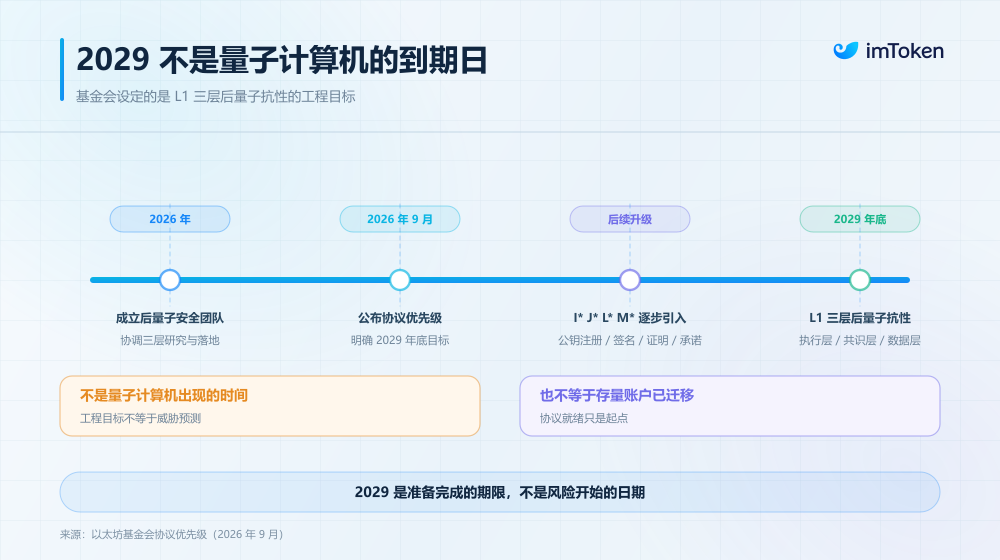
Proposals, not deployed protections
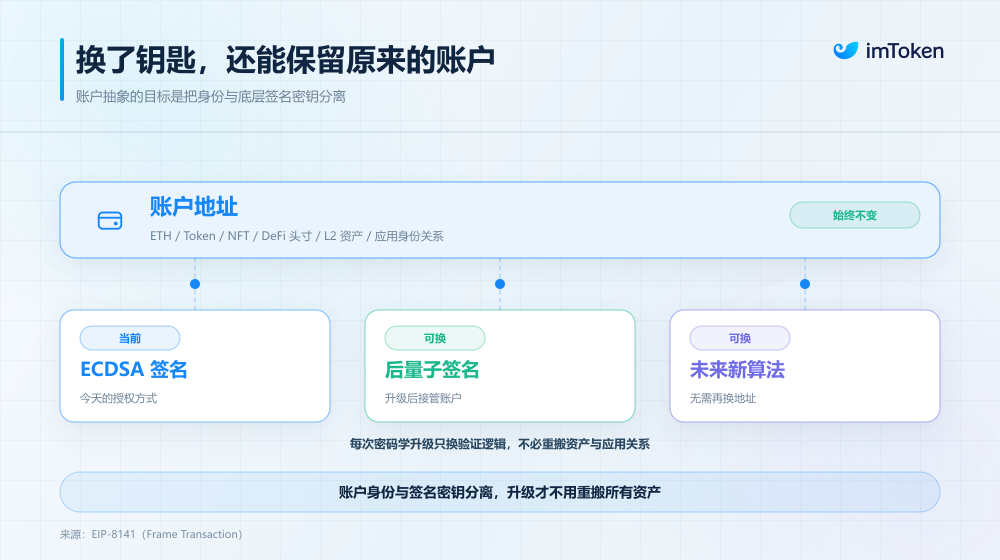
On the execution layer, the report identified EIP-8141 as a native account-abstraction proposal. Its approach separates transaction validation, execution and gas payment, creating room for programmable authorization and, potentially, different signature schemes. This does not mean existing externally owned accounts can already rotate to post-quantum keys while retaining their addresses. The report also described research into precompiles for verifying post-quantum signatures and EIP-8288, a proposal to use recursive STARK aggregation to reduce the on-chain burden of verifying many such signatures.
For consensus, the Lean Ethereum directions described in the report were leanXMSS, a proposed hash-based alternative to validator BLS signatures, and leanVM, intended to aggregate post-quantum signature checks into compact proofs. Neither was presented as an activated replacement. Data-layer commitments and affected rollup proof systems would need their own migration paths; changing account signatures alone would not complete the work.
The account-migration problem
For a conventional externally owned account, adopting a new key system would ordinarily mean a new account identity and moving assets. That could involve not only ETH and tokens but NFTs, DeFi positions, L2 assets and application permissions tied to an address. Programmable account validation could, in principle, make key changes less disruptive, but the report did not establish a universal migration method for existing accounts.
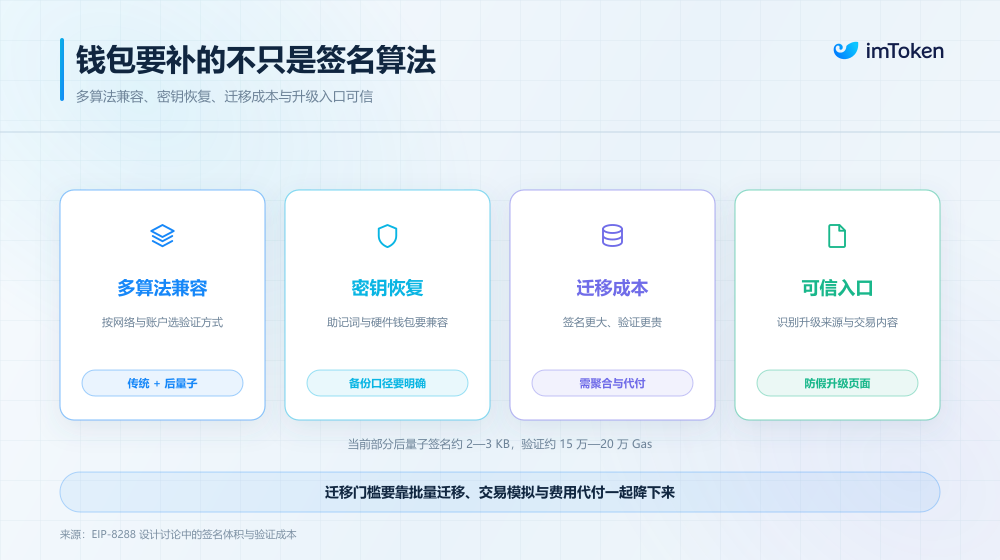
Timing matters. While an old key remains secure, its owner could authorize an updated validation rule. If an attacker could already derive that key, an old-key signature alone might no longer establish who the rightful owner is. Dormant or lost-key accounts present another unresolved question: the report described possible measures, including freezing, as a matter of debate, not an adopted rule.
The report also warned that purported “quantum-safe upgrades” or migration pages could be used to solicit seed phrases or malicious approvals. Its practical distinction was clear: advance preparation matters for protocol and wallet developers, but the reported state of quantum hardware did not call for users to rush an asset transfer.