Aave Labs’ 180-day report, published on November 13, 2026, describes a lending ecosystem expanding beyond its core markets while taking on more development and maintenance work. As reported on November 18, the central contrast was clear: Aave’s deposits recovered sharply in the third quarter, but protocol revenue fell.
A larger development operation
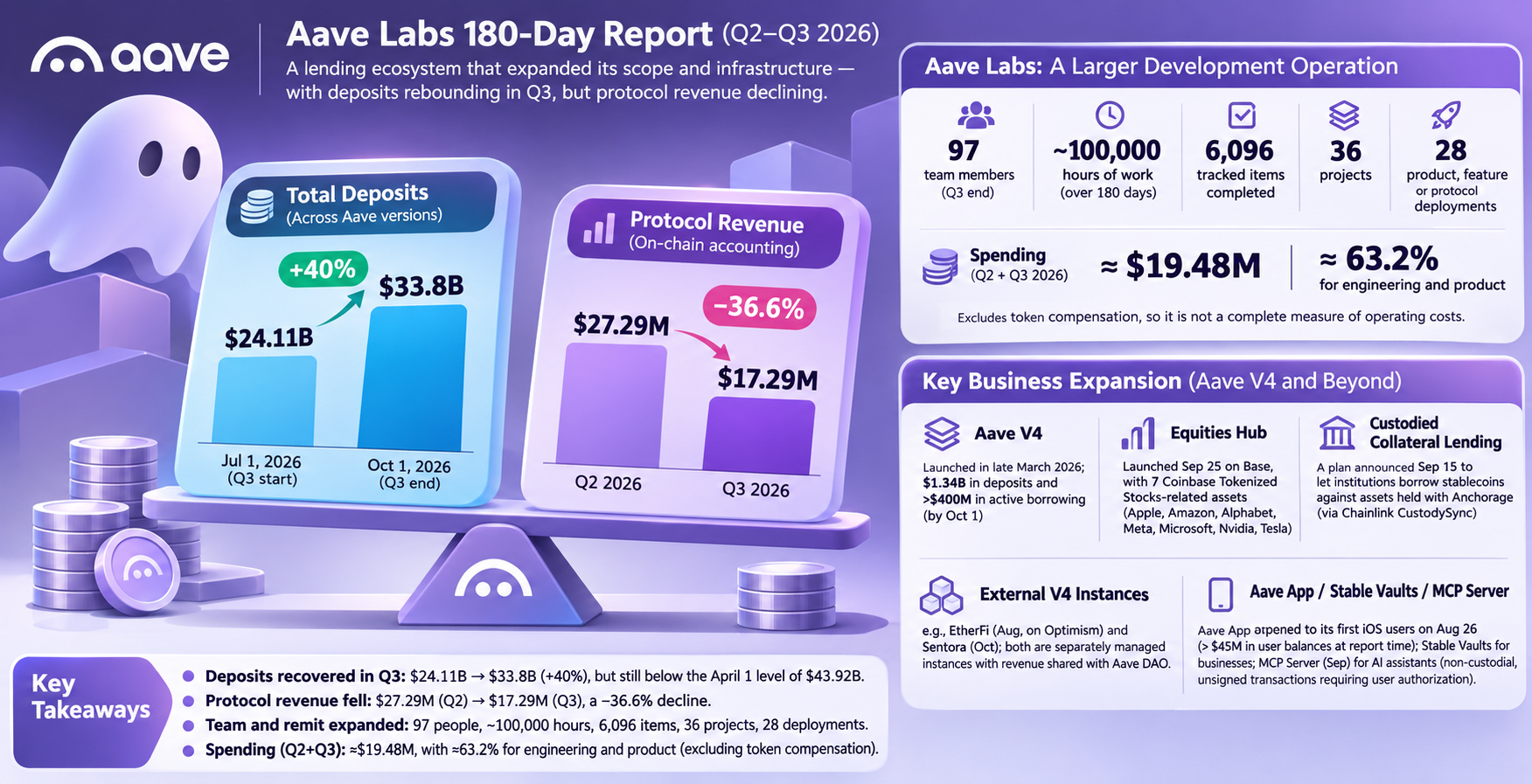
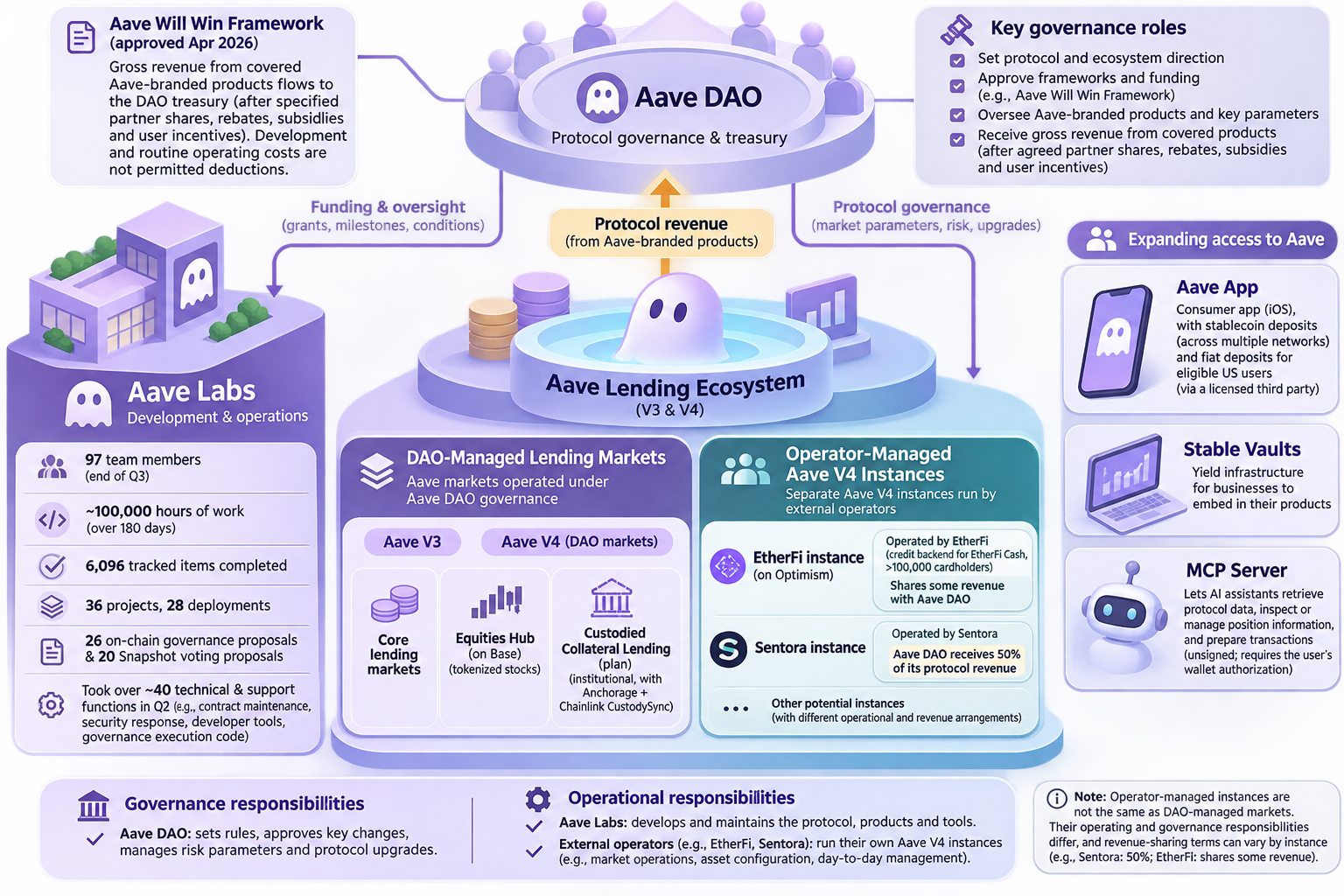
Aave Labs had 97 team members at the end of the third quarter. Over the preceding 180 days, it reported approximately 100,000 hours of work, 6,096 tracked items completed, 36 projects and 28 product, feature or protocol deployments. The team also led the drafting of 26 on-chain governance proposals and 20 Snapshot voting proposals. Twenty-three people joined and 23 left during the period; departures included voluntary exits and roles eliminated in a reorganization.
Second- and third-quarter spending totaled approximately $19.48 million, with engineering and product accounting for about 63.2%. That figure excludes token compensation, so it is not a complete measure of Aave Labs’ operating costs.
In the second quarter, Aave Labs took over roughly 40 technical and support functions previously handled by BGD Labs and the Aave Chan Initiative. They included contract maintenance, security response, developer tools and code to execute governance proposals. The broader remit helps explain why the report covers more than new product development.
The funding relationship with Aave DAO also changed. In April 2026, the DAO approved the Aave Will Win Framework. Under its terms, gross revenue from covered Aave-branded products flows to the DAO treasury after specified external partner shares, rebates, subsidies and direct user incentives; development and routine operating costs are not permitted deductions. Aave Labs’ previously published funding request comprised a $25 million primary grant, a $17.5 million growth grant tied to products and milestones, and 75,000 AAVE vesting over four years. The grants were subject to payment schedules and conditions, rather than being payable entirely at once.
Why deposits and revenue moved in opposite directions
Across Aave protocol versions, deposits rose from $24.11 billion at the start of July to $33.8 billion on October 1, an increase of about 40%. Borrowing grew from $10.18 billion to $13.3 billion, or roughly 31%. Yet deposits remained below their April 1 level of $43.92 billion.
Aave Labs attributed much of the second-quarter deposit decline to a security incident involving the rsETH cross-chain bridge and a broader DeFi market contraction. On April 18, an attacker obtained 116,500 rsETH on Ethereum without corresponding cross-chain burn records, deposited 89,567 rsETH as collateral across eight Aave V3 positions, and borrowed 82,650 WETH and 821 wstETH. The incident was not a breach of Aave’s own smart contracts, but the resulting borrowing exposed Aave markets to risk. Following governance actions, liquidations and asset replenishment, rsETH backing was restored on May 26 and the affected markets resumed normal operation. Aave Labs also said the response delayed some product releases until the third quarter.
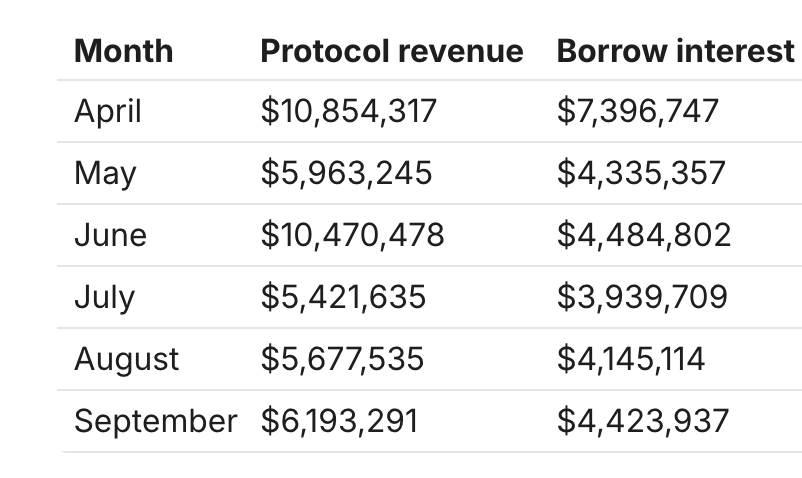
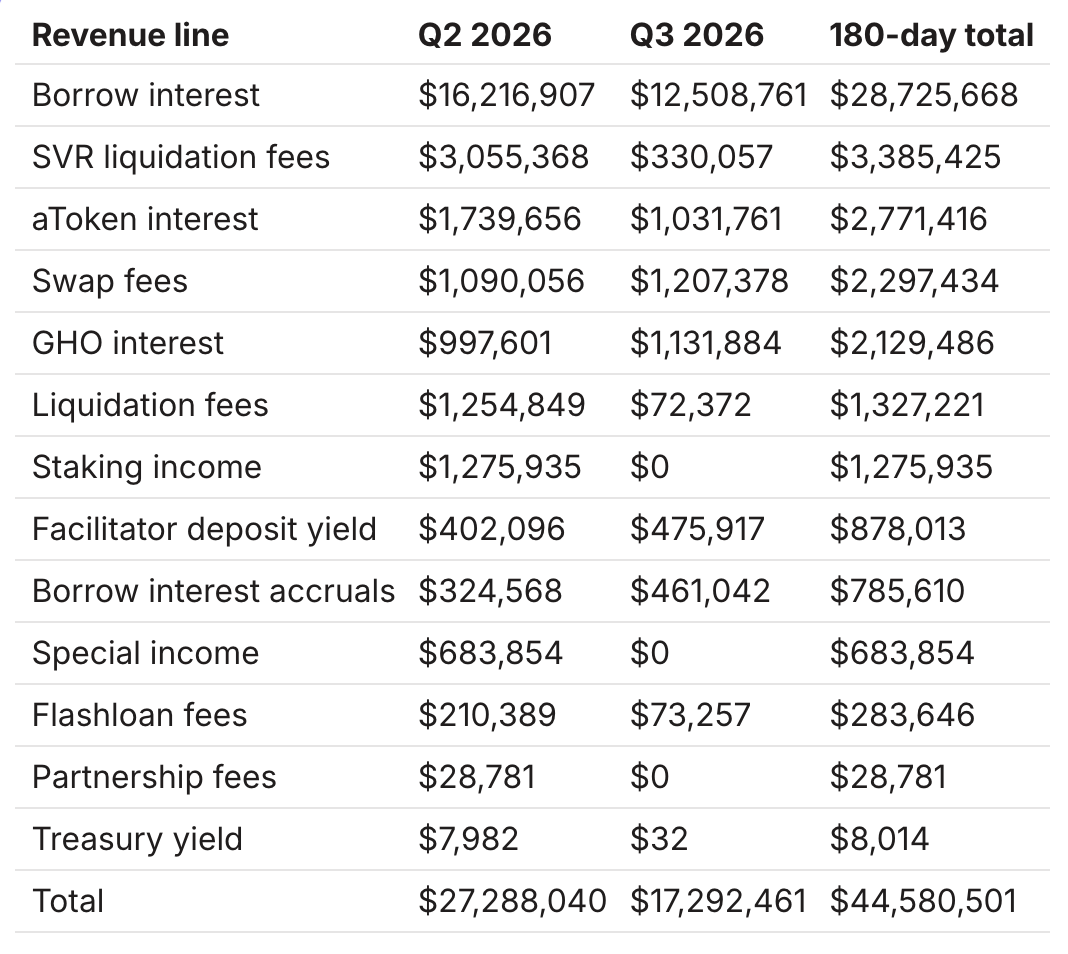
Under Aave Labs’ on-chain accounting, protocol revenue declined from approximately $27.29 million in the second quarter to $17.29 million in the third, a drop of about 36.6%. Of the roughly $44.58 million earned across both quarters, borrowing interest contributed about $28.73 million, or 64.4%; other sources included liquidation-related fees, swap fees and GHO interest.
The revenue mix matters. Chainlink SVR liquidation-related fees fell from approximately $3.06 million in the second quarter to $330,100 in the third, while ordinary liquidation fees fell from about $1.25 million to $72,400. Borrowing interest also declined, from roughly $16.22 million to $12.51 million. Third-quarter deposit growth therefore did not translate into higher revenue. GHO interest rose about 13% quarter over quarter, swap fees about 11%, and stablecoin borrowing about 11%; reported stablecoin utilization increased from approximately 75% to 79%.
V4’s expanding set of markets
Aave V4 launched in late March 2026. By October 1, it had reached $1.34 billion in deposits and more than $400 million in active borrowing—a relatively small share of Aave’s $33.8 billion in total deposits.
Several V4 initiatives show the different arrangements Aave is testing. On September 25, an Equities Hub launched on Base with support for seven Coinbase Tokenized Stocks-related assets, linked to Apple, Amazon, Alphabet, Meta, Microsoft, Nvidia and Tesla. Eligible users could use those assets as collateral to borrow without selling the tokens.
A separate Custodied Collateral Lending plan, announced on September 15, would allow institutions to borrow stablecoins against assets held with Anchorage, with balance information synchronized on-chain through Chainlink CustodySync. It was a plan, not a description of an already operating market. Verifying custody, carrying out liquidations and allocating responsibility after a default remain distinct challenges for such an arrangement.
V4 also supports instances managed by outside operators. In August, EtherFi moved the credit backend for EtherFi Cash to a dedicated Aave V4 instance on Optimism, serving its more than 100,000 cardholders. EtherFi manages that instance and shares some revenue with Aave DAO. Sentora launched a separately managed instance in October; under the disclosed arrangement, the DAO receives 50% of its protocol revenue. These instances should not be confused with markets managed directly by the DAO: operating and governance responsibilities differ.
New ways to reach users
Beyond lending-market infrastructure, Aave Labs reported work on interfaces for consumers, businesses and software agents. The Aave App opened to its first iOS users through Ghost Passes on August 26. According to the report, it supported stablecoin deposits from Arbitrum, Ethereum, Base, HyperEVM and BNB Chain, while eligible US users could access fiat deposits through a licensed third party. App user balances exceeded $45 million when the report was disclosed. Stable Vaults, by contrast, was designed for businesses embedding stablecoin yield functionality in their own products.
In September, Aave Labs released an official MCP Server that lets AI assistants retrieve protocol data, inspect or manage position information, and prepare transactions. It does not custody funds: transactions it generates are unsigned and still require authorization from the user’s wallet. The report did not provide active-user, transaction-volume or revenue figures for the MCP Server, so its commercial uptake remains unestablished.
Taken together, the report documents a wider role for Aave Labs and more ways to distribute Aave-based services. Whether those efforts produce durable revenue—and how the DAO balances oversight with reliance on a major service provider—remains unresolved.