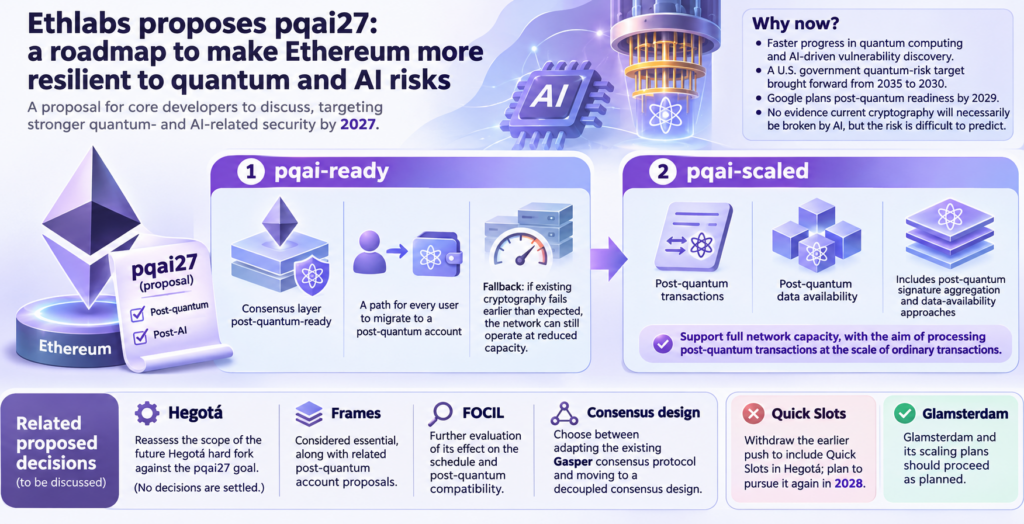
In a proposal reported on November 12, 2026, Ethlabs set out a target for Ethereum to become more resilient to quantum-computing and AI-related security risks by 2027. It calls the proposed effort “pqai27.” This is a roadmap proposal for core developers to discuss, not an approved upgrade or an activated network change.
Ethlabs argues that faster progress in quantum computing and AI-driven vulnerability discovery warrants earlier security work. It cites a US government quantum-risk target brought forward from 2035 to 2030 and Google’s plan to achieve post-quantum readiness by 2029. Ethlabs also says AI is solving long-standing mathematical problems and finding software vulnerabilities at scale. It acknowledges that there is no evidence current cryptographic primitives will necessarily be broken by AI, but considers the risk difficult to predict.
Two proposed milestones
- “pqai-ready” would make Ethereum’s consensus layer post-quantum-ready and give every user a path to migrate to a post-quantum account. Ethlabs proposes that, if existing cryptography fails earlier than expected, the network should still be able to operate at reduced capacity.
- “pqai-scaled” would support post-quantum transactions and data availability at full network capacity, with the aim of processing post-quantum transactions at the scale of ordinary transactions. The proposed work includes post-quantum signature aggregation and data-availability approaches.
Ethlabs recommends reassessing the scope of the future Hegotá hard fork against that goal. It considers Frames and related post-quantum account proposals essential, while calling for further evaluation of FOCIL’s effect on the schedule and post-quantum compatibility. Developers would also need to choose between adapting the existing Gasper consensus protocol and moving to a decoupled consensus design.
To focus resources on pqai27, Ethlabs says it will withdraw its earlier push to include Quick Slots in Hegotá and plans to pursue the feature again in 2028. It says Glamsterdam and its scaling plans should proceed as planned. None of these proposed Hegotá decisions is settled; they remain subject to discussion among Ethereum core developers.