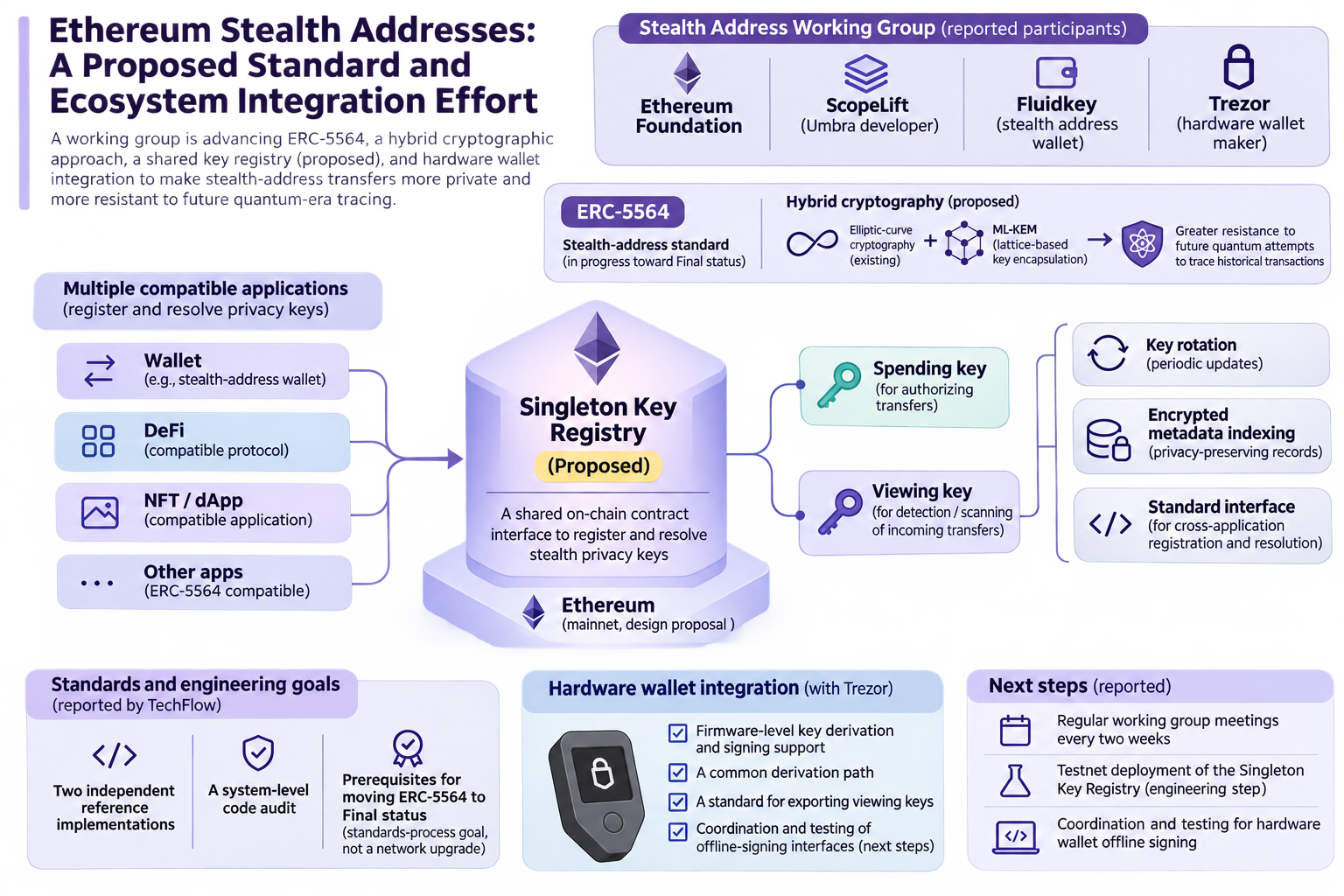
In a report published on November 18, 2026, TechFlow said Pierre, a member of the Ethereum Foundation’s privacy research effort, had announced a stealth address working group. The reported participants include the Ethereum Foundation, Umbra developer ScopeLift, stealth address wallet Fluidkey and hardware wallet maker Trezor. The group plans to meet every two weeks to work on ERC-5564 and its integration with hardware wallets.
The proposed standards work
According to the report, the group proposes a hybrid approach combining existing elliptic-curve cryptography with ML-KEM, a lattice-based key encapsulation mechanism. Its stated aim is to make stealth-address transfers more resistant to future attempts to trace historical transactions using quantum computers.
The group also intends to build an independent, production-grade reference implementation. TechFlow describes two independent reference implementations and a system-level code audit as prerequisites for moving ERC-5564 to Final status. That is a standards-process goal, not an activated Ethereum network upgrade.
Shared registry and wallet integration
To address the need to register stealth meta-addresses across applications, the group plans a Singleton Key Registry contract on Ethereum mainnet. The proposed shared interface would let compatible applications register and resolve privacy keys, with separate spending and viewing permissions, key rotation and encrypted metadata indexing. The report describes testnet deployment of the contract as an upcoming engineering step; it does not report a mainnet deployment.
The group is also working with Trezor on firmware-level key derivation and signing support. Its stated goals include a common derivation path and a standard for exporting viewing keys, so hardware wallets can support stealth-address interactions without exposing a primary private key. The report lists coordination and testing of offline-signing interfaces among the next steps, rather than describing completed wallet support.