As reported on November 18, 2026, Ethereum’s preparations for a possible future quantum threat extended beyond choosing replacement cryptography. The harder question for users was how to retain control of existing accounts and assets while changing the keys and verification rules that protect them.
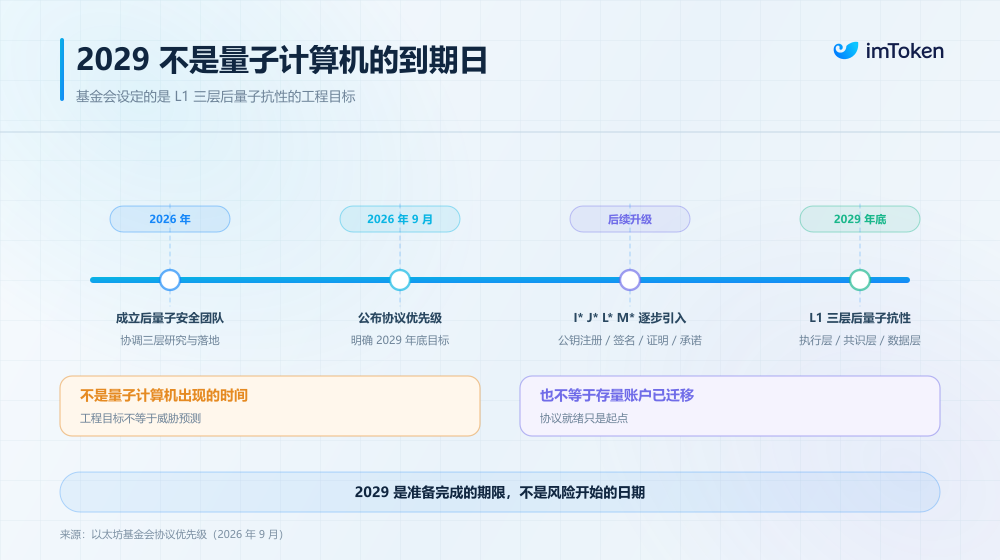
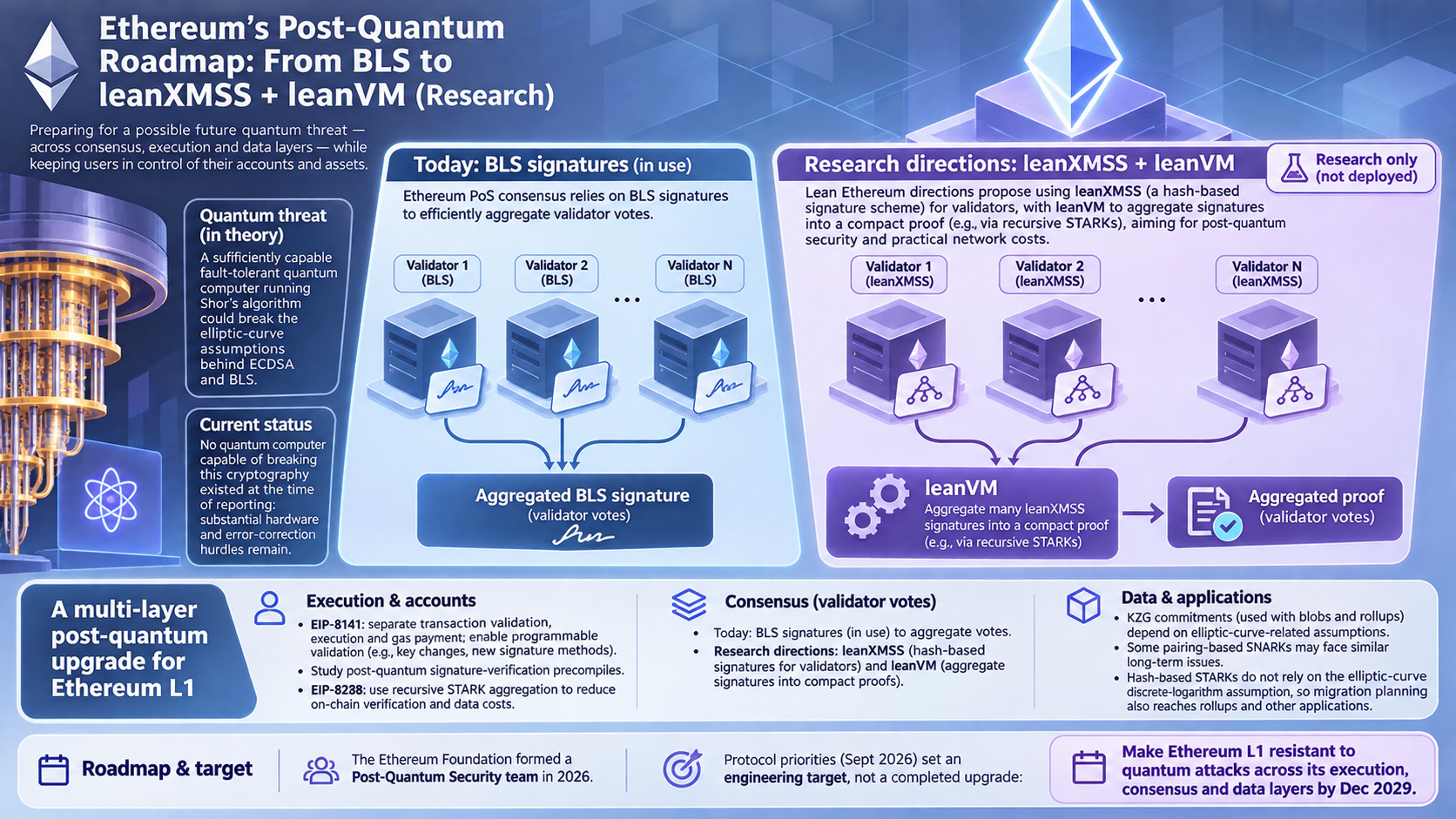
According to imToken’s account of the roadmap, the Ethereum Foundation had formed a Post-Quantum Security team in 2026. Protocol priorities published that September set an engineering target, not a completed upgrade: making Ethereum L1 resistant to quantum attacks across its execution, consensus and data layers by December 2029.
Why accounts face different risks
A sufficiently capable fault-tolerant quantum computer running Shor’s algorithm could, in theory, undermine the elliptic-curve assumptions behind ECDSA account signatures and BLS validator signatures. The article notes that no quantum computer capable of breaking this cryptography existed at the time of reporting; the threat still faced substantial hardware and error-correction hurdles.
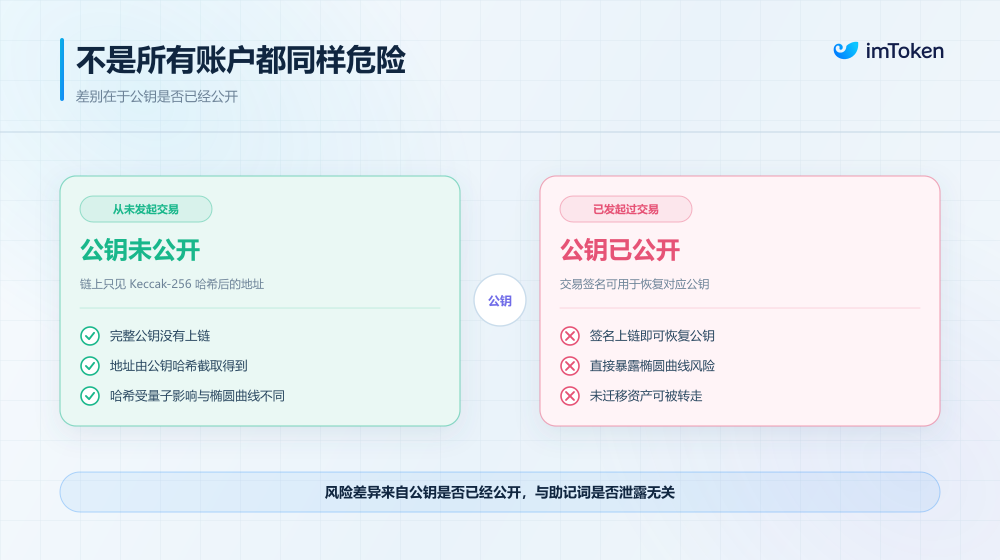
For an ordinary externally owned account (EOA), public-key exposure matters. Its address is derived by hashing a public key with Keccak-256. If the account has never sent a transaction or disclosed a signature elsewhere, its full public key is not exposed by the address alone. Once it sends a transaction—including a contract approval—the public signature can reveal that key, creating a different risk if elliptic-curve cryptography is eventually broken. Hash functions such as Keccak-256 face a different quantum threat: Grover’s algorithm offers a quadratic speedup, rather than the kind of break Shor’s algorithm poses to the cited public-key systems.
Proposed changes across three layers
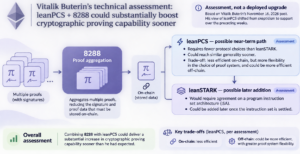
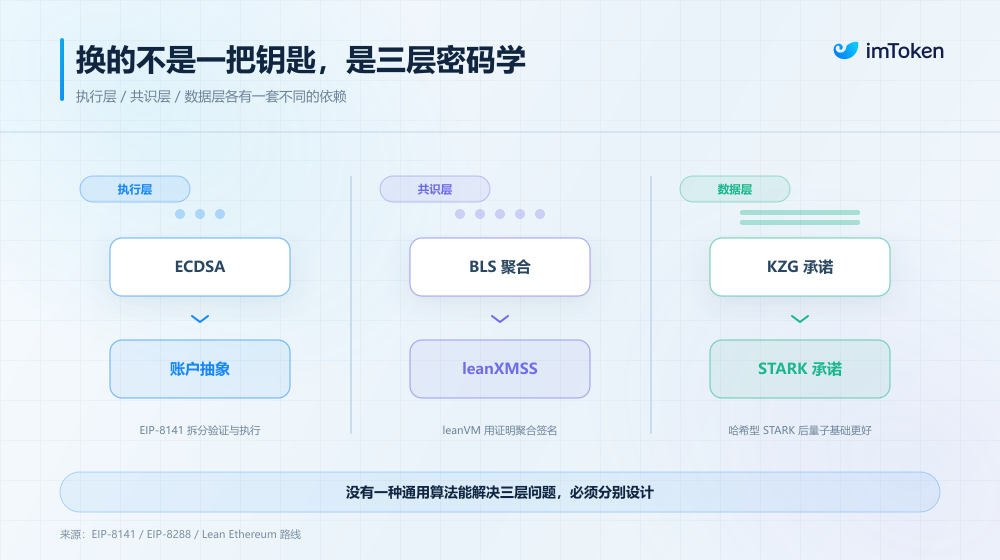
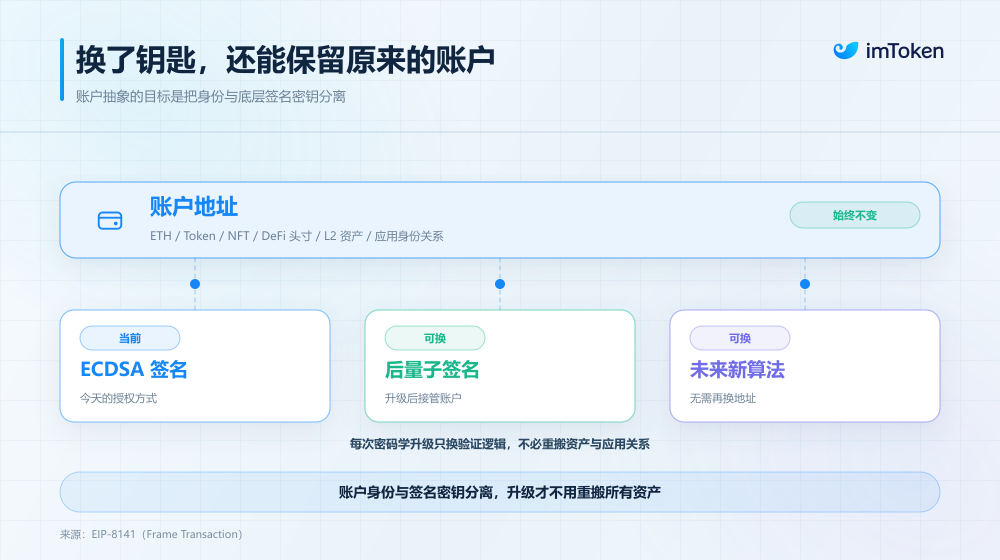
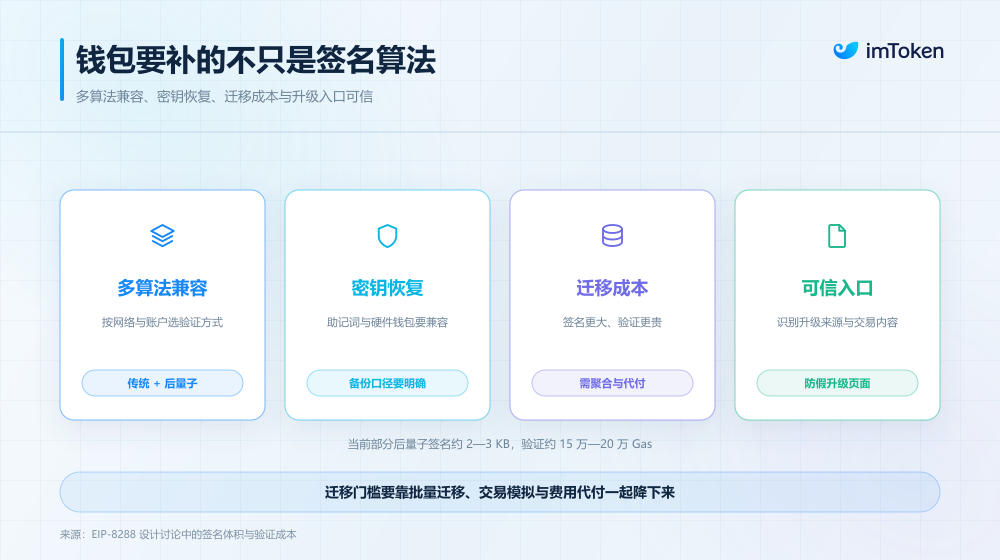
Execution and accounts. Today’s EOA authorization is tied to a secp256k1 key and ECDSA verification. The proposed EIP-8141 would separate transaction validation, execution and gas payment into distinct stages. As described by imToken, programmable validation could help accounts change keys or adopt other signature methods without permanently binding account control to ECDSA. That is a proposed capability, not a deployed account upgrade. Post-quantum signature-verification precompiles are also being studied. Because replacement signatures can be much larger, the proposed EIP-8288 explores recursive STARK aggregation to reduce on-chain verification and data costs.
Consensus. Ethereum’s proof-of-stake system relies on BLS signatures to aggregate validator votes. Simply substituting larger post-quantum signatures would increase network propagation, storage and verification costs. The Lean Ethereum directions described in the article include leanXMSS, a hash-based signature scheme proposed for validators, and leanVM, intended to aggregate such signatures into compact proofs. Neither is presented here as an activated change.
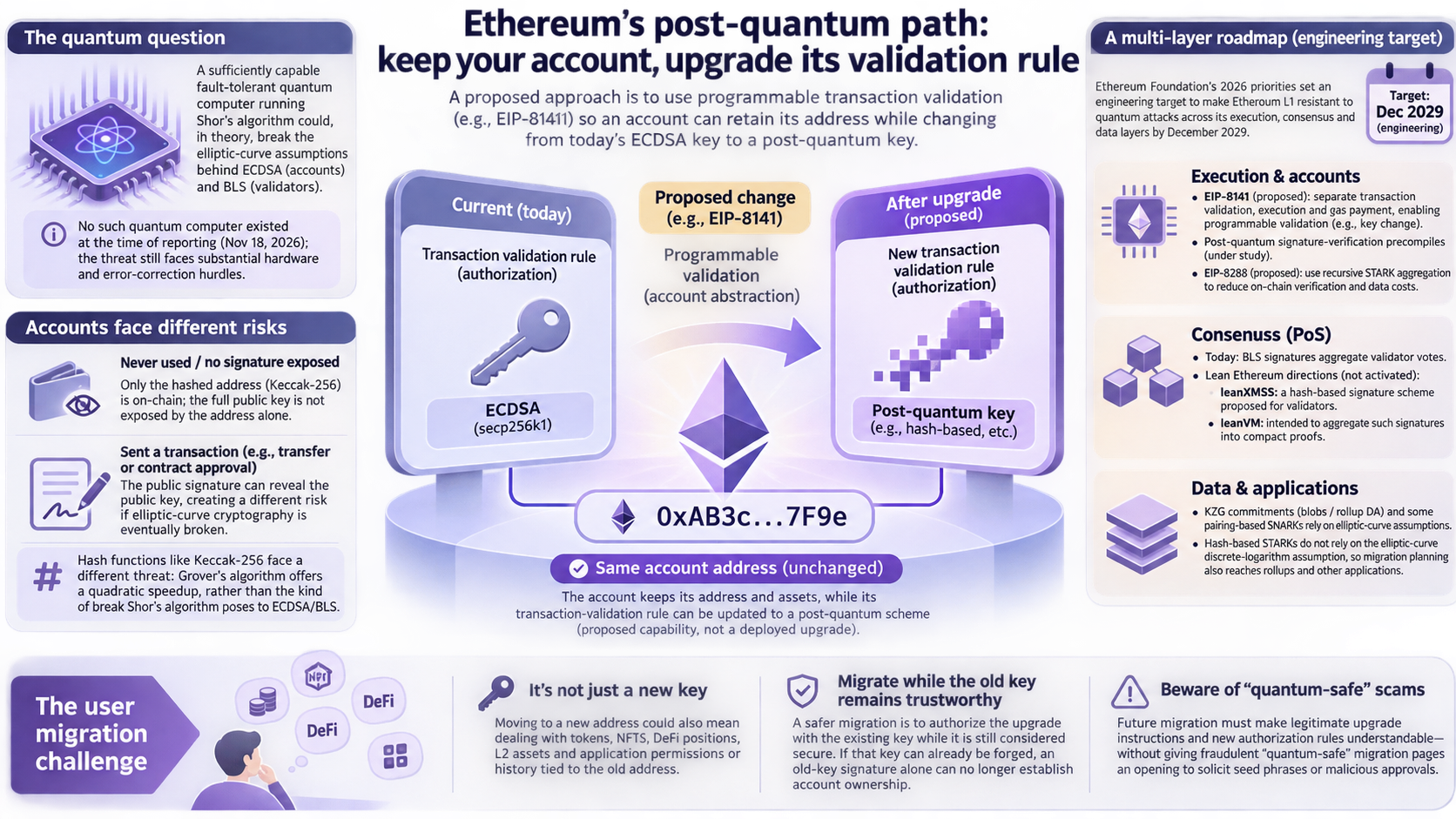
Data and applications. KZG commitments used with blobs and rollup data availability depend on elliptic-curve-related assumptions. Some pairing-based SNARKs used by applications may face a similar long-term issue. Hash-based STARKs do not rely on the elliptic-curve discrete-logarithm assumption, so migration planning also reaches beyond L1 to rollups and other applications.
The unresolved user migration
Generating a new key is not the same as preserving an account. Moving an EOA to a new address could also require users to deal with tokens, NFTs, DeFi positions, L2 assets and application permissions or history associated with the old address. Programmable account validation could, in principle, let an account retain its address while changing who can authorize transactions, but that outcome depends on the eventual design and deployment.
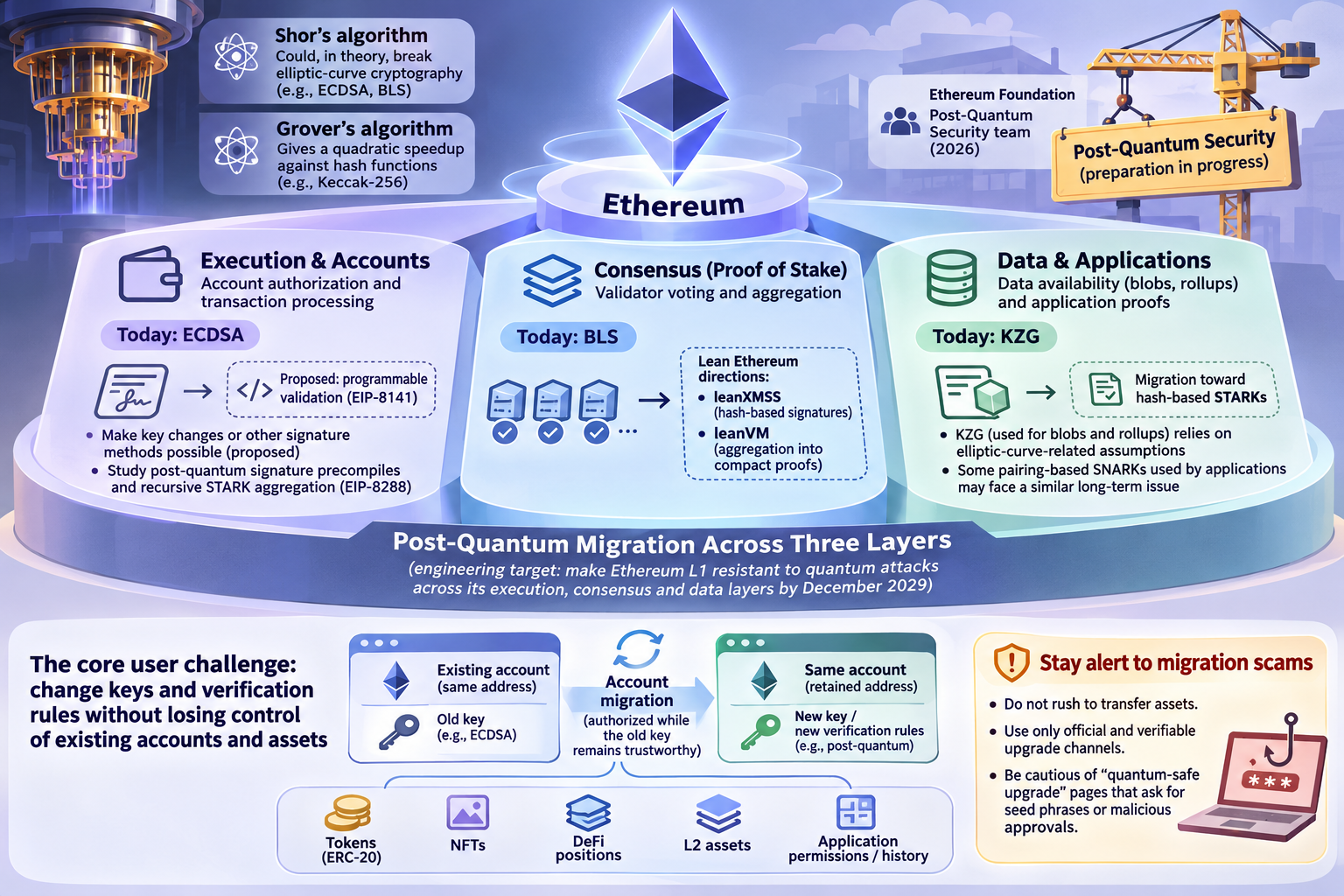
The safest migration envisioned in the article would be authorized with the existing key while it remains trustworthy. If attackers could already forge signatures from that key, an old-key signature alone would no longer establish who owns the account. Dormant accounts, lost keys and owners unaware of an upgrade pose further unresolved questions; possible measures such as freezing assets remain matters of debate, not adopted policy.
For users, the immediate conclusion in the November 2026 report was not to rush an asset transfer. It was that any future migration must make legitimate upgrade instructions and new authorization rules understandable—without giving fraudulent “quantum-safe” migration pages an opening to solicit seed phrases or malicious approvals.