Reporting published on November 24, 2026 described Commodity Futures Trading Commission staff guidance issued on November 23, 2026. Under that advisory, swap execution facilities, designated contract markets, and derivatives clearing organizations may count Bitcoin, Ether, and qualifying payment stablecoins toward certain financial resource requirements. The text is a staff advisory, not a binding rule adopted by the full Commission. It does not amend existing regulations or create enforceable rights, and nothing in it requires institutions to buy Bitcoin.
Those three types of venue must maintain sufficient financial resources to cover at least one year of operating costs. The November 23 guidance says Bitcoin, Ether, and qualifying payment stablecoins may contribute to that calculation, subject to valuation discounts. The clarification concerns assets the institutions that run the markets can rely on to support operations. It is not guidance on what traders may post as collateral. For a firm that already holds Bitcoin, the reporting says the clarification could make those holdings more useful from a regulatory standpoint. For a firm considering adding cryptocurrency to its balance sheet, it could reduce uncertainty about how those assets would be recognized. Recognition still comes at a discount.
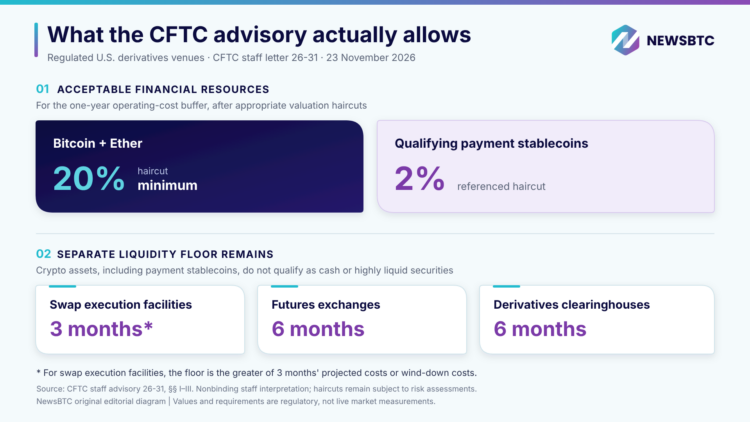
The advisory references a minimum 20% valuation haircut for Bitcoin and Ethereum, consistent with earlier staff treatment of proprietary cryptocurrency positions held by futures commission merchants. Qualifying payment stablecoins are referenced with a 2% haircut. An exchange holding $10 million in Bitcoin could count $8 million toward the relevant financial resource requirement if it applied a 20% haircut and no further deductions were necessary. The remaining $2 million is not described as a realized loss. It is a regulatory adjustment for the risk of holding a volatile asset. Crypto assets that are neither readily marketable nor qualifying payment stablecoins would generally face a 100% haircut, which would exclude them from the calculation.
Staff also address wrong-way risk. The November 23 advisory states: “A DCM should consider potential wrong-way risk.” For a cryptocurrency-focused exchange, a prolonged Bitcoin sell-off could pressure trading revenue while also reducing the value of assets the exchange relies on to support operations. The problem identified in the reporting is not only that Bitcoin is volatile, but that its value could fall at the same time a crypto business is under financial pressure. A 20% discount is described as some protection against that scenario, not a guarantee.
A separate requirement for cash and highly liquid securities stays closed to these holdings. Bitcoin, Ethereum, and qualifying payment stablecoins cannot be used to meet that obligation under the advisory. Swap execution facilities must keep qualifying liquid resources sufficient to cover at least three months of projected operating expenses or the cost of winding down operations, whichever is greater. For designated contract markets and derivatives clearing organizations, the operating-cost liquidity requirement generally covers at least six months. An institution can therefore have substantial balance-sheet assets without having the cash to meet immediate obligations. The guidance also does not address whether cryptocurrencies can satisfy the separate financial resources that clearinghouses must maintain to cover clearing-member defaults.
The reporting treats the result as limited recognition rather than a purchase mandate. An exchange that already owns Bitcoin could benefit without buying another coin. Another could still find conventional securities more efficient because of the haircuts and the separate liquidity rule. No purchase commitments were disclosed with the advisory, and the reporting warns against reading the document as a bullish price forecast. It distinguishes allowing an institution to count Bitcoin from giving that institution an economic incentive to buy more. Longer-term, the same reporting suggests that another recognized use inside regulated markets may matter more than any immediate trading impact, while stressing that this remains staff guidance. The next development it identifies is evidence that regulated institutions actually change reserve allocations. Until then, the November 23 document is another form of staff-level recognition, not proof of sustained buying.
Earlier reporting cited alongside the advisory covered CFTC guidance on tokenized collateral at clearinghouses, a separate question from operating resources. It also noted Coinbase’s CFTC registration for a USDC-focused derivatives clearinghouse as an example of a crypto business operating inside an established derivatives framework. Neither point changes what this advisory does. For Ether, the November 23 text does not alter Ethereum protocol rules, client software, or any network upgrade. For this operating-resource calculation only, it places Ether in the same referenced haircut category as Bitcoin, while qualifying payment stablecoins receive the smaller referenced discount.